


“Systems Engineering Is No Longer a Nice-to-Have”
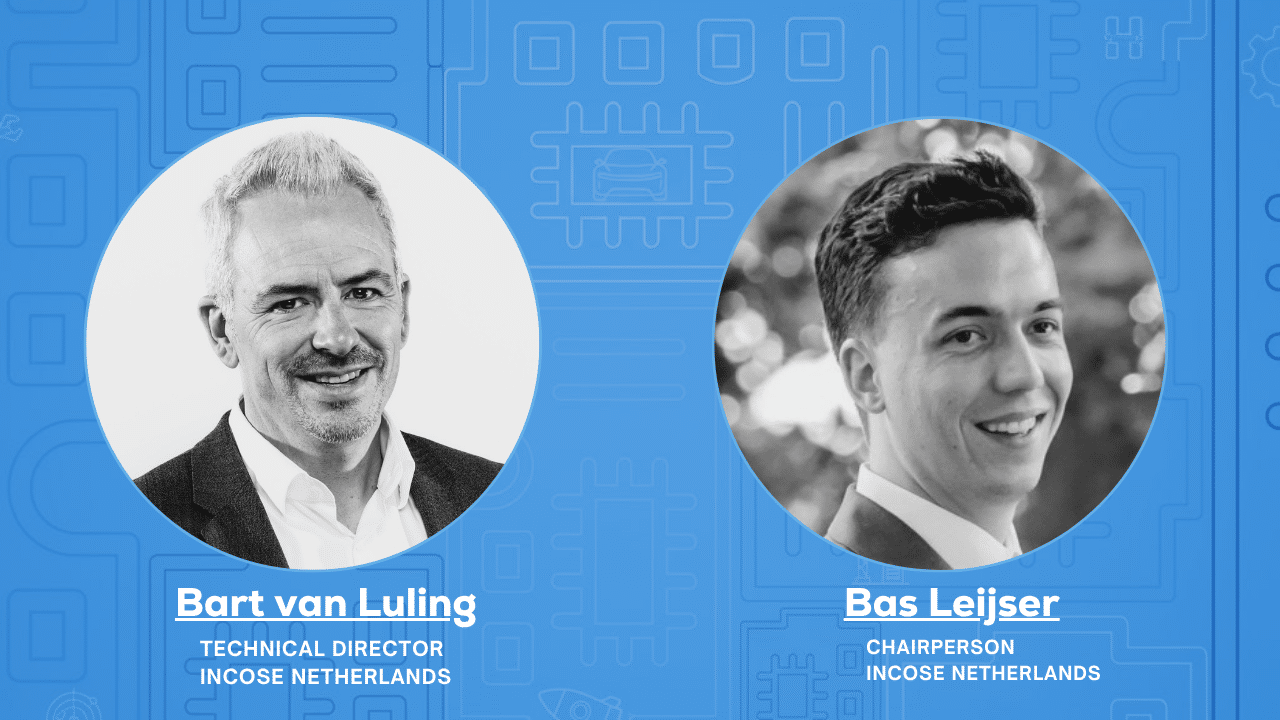
INCOSE NL was founded in 1996 by 25 engineers who believed complex systems needed a discipline of their own. Thirty years and nearly 500 members later, technical director Bart van Luling and chairman Bas Leijser take stock — of what SE has become, where it still falls short, and why the next two days in November might matter more than any event in the organization’s history.
In November, the High Tech Institute will co-organize the Dutch Systems Engineering Days — the largest SE gathering in the Netherlands to date, and the centrepiece of INCOSE NL’s 30th anniversary. To understand what that milestone actually represents, we spoke with technical director Bart van Luling and chairman Bas Leijser across a range of questions: the discipline’s origins, its spread into new sectors, the honest reckoning with AI, and what Dutch industry still consistently underestimates. Their answers are reproduced here in full.
Why SE needed its own organisation
INCOSE NL started in 1996 with 25 people in a country that already had a strong engineering culture. Looking back, why did it take a separate organisation to make Systems Engineering happen here?
Bas Leijser
I can mainly speak for the past decade, but one thing is clear, regardless of when you joined: Systems Engineering seldom emerges organically, even in strong engineering cultures.
SE requires deliberate effort and coordination, rooted in common practices and a shared language. That’s precisely where an organization like INCOSE NL is essential. We provide that foundation and, in addition, serve as a neutral platform connecting industry, government, and academia.
Our network member meetings, workshops, and now the Dutch SE Days facilitate knowledge sharing and networking. Our INCOSE handbook, the work of our Special Interest Groups and international Working Groups, and our certifications together form the backbone of SE practice and professional recognition, ensuring that the discipline grows into something shared and sustained across the field.
The discipline’s evolution
Systems Engineering was originally developed in defense and aerospace, yet INCOSE NL has always attracted members from public infrastructure, process industry, and the high-tech sector. Thirty years on — how would you describe the place Systems Engineering holds in the Netherlands today?
Bart van Luling
SE by now has a strong foundation in multiple sectors. In the 2000s, SE was implemented broadly in the Dutch infrastructure and civil engineering sector and evolved to standardized ways of working for the major public employers like Rijkswaterstaat, ProRail, multiple provinces, municipalities, and water authorities — and the big contractors and engineering companies. In past years, within the energy sector, multiple organisations like TSO TenneT, DSOs Alliander, Stedin, and Enexis have been implementing SE following the trend in infrastructure. Recently there have been first steps within the health sector and urban area development. The SE community is significantly growing across multiple sectors.
Bas Leijser
Systems Engineering in the Netherlands has evolved well beyond its roots in defense and aerospace. We now see strong adoption across energy, infrastructure, and high-tech, and are expanding into new territory like healthcare, driven by a growing recognition that complexity is increasing across all sectors, and that SE plays a key role in managing it.
But perhaps the more interesting evolution is in how people identify with the discipline. Not everyone calls themselves a systems engineer, but more and more people recognize themselves as system thinkers, integrators, system architects, and so on. The boundaries of who “belongs” in SE are widening, and we welcome that at INCOSE NL. The discipline is finding people as much as people are finding the discipline.
The membership curve — and what drove it
Membership grew from 25 at the start to 100 in 1999, 270 in 2005, and over 350 by 2021 — now exceeding 400. Are there moments in that curve that stand out as genuinely pivotal?
Bart van Luling
The growth in the period between 1999 and 2005 resonates directly with the introduction of SE in the civil engineering sector. Since joining as technical director in 2023, our strategy has focused on attracting younger engineers and reaching new sectors — and that paid off. The community is still growing in numbers, in the range of sectors involved, and with younger members.
Bas Leijser
As of March 2026, we had over 490 members and expect to surpass 500 this year.
On the growth itself, the honest answer is that there’s no single pivotal moment. It’s more of a combination of inflection points. What we see is a gradual but accelerating shift in how organisations perceive SE. It used to be something almost niche, but now we see people from a much wider range of sectors and roles joining.
The underlying drivers are clear: systems are becoming more software-intensive, more interconnected, more complex. AI adds another layer of uncertainty on top of that. Better MBSE tooling has lowered the barrier to applying SE in practice, which brings in people who might have found it inaccessible before. The net effect is that SE has shifted from a ‘nice to have’ to something organisations increasingly treat as a prerequisite. That’s what the membership curve reflects as well.
'SE has shifted from a 'nice to have' to something organisations increasingly treat as a prerequisite.'
AI meets SE — including what doesn’t work
One of your recent member events focused on “AI meets Systems Engineering — what works, what doesn’t, and what’s coming.” That framing — acknowledging what doesn’t work — is refreshingly honest. What have been the genuinely disappointing early experiences?
Bart van Luling
For me, there is no disappointment. Results with the use of AI for systems engineering are very promising. But it’s all about expectations. If people expect AI to take over their SE tasks just like that, they come home empty-handed. There is a lot of thinking, experience, and creativity needed in applying systems engineering for complex assignments. AI can reproduce what has been done before and what’s documented, and do easy tasks much faster than people. But it cannot do that without clear instructions and without someone doing the thinking for it — at least, not yet. Just uploading a bunch of SE documents and trying AI to give good advice is a bit short-sighted. We have to treat AI as a very fast-working intern with a photographic memory.
Bas Leijser
Most of the disappointing experiences turned out to be a matter of patience. I’ve had more than a dozen conversations where someone said “AI can’t do X yet” — and then six to twelve months later, that point was moot.
Of course, there are the expected technical limitations, like hallucinations or AI struggling with more complex tasks.
But the toughest disappointment is on the human side: coming to terms with the fact that AI can be genuinely capable, and that the real challenge is adapting ourselves. The disappointment isn’t in AI failing but in AI succeeding, and realizing that many things we thought only we could do with our expertise turned out to be perfectly manageable by AI — with a little guidance. Accepting that and learning to work with it can turn that disappointment into excitement, but that’s not a one-time shift; it’s a continuous process.
'The disappointment isn't in AI failing but in AI succeeding — and realizing that many things we thought only we could do turned out to be perfectly manageable by AI, with a little guidance.'
From document to model
Your MBSE Special Interest Group has been active for years. How far along is Dutch industry actually in making that shift in practice, and where do you still see the biggest barriers?
Bart van Luling
There is not one answer to this question — it differs a lot per sector. In high tech and automotive, MBSE is well developed and broadly applied. In infrastructure and civil engineering it’s still in its infancy, but first steps are being made, for example in the Dutch national standard for tunnel systems. In the energy sector there is a big transition ongoing from a document-based way of working to a data-centric approach, but I personally haven’t seen real MBSE examples yet. I do believe Dutch industry is a bit behind on MBSE developments compared to other countries.
Bas Leijser
The shift from document-based to model-based working is less of a technical challenge and more of a change management and people challenge. It requires a fundamental mindset change. We often hear at INCOSE events that we should get better at social sciences, because that’s really what drives adoption.
As for maturity across Dutch industry, it’s uneven. Some organisations have embedded MBSE and are quite far along. Others are still finding their way — it can genuinely be a multi-year process to get from document-heavy practices to capturing requirements in a structured database.
Across the board, the biggest barriers are not the tools themselves, but adoption at scale: aligning stakeholders, integrating MBSE into existing processes, and making the value visible early enough to sustain the transition.
The Dutch SE Days — who should be in the room
The Dutch Systems Engineering Days in November are shaping up to be the biggest SE gathering in the Netherlands in years. What are you most excited about — and who should be there?
Bart van Luling
I’m especially excited that we are bringing sectors together to learn and get inspired by each other’s SE experiences. We need to share knowledge to bring SE to the next level in the Netherlands. Also, I really like that we have a student track to stimulate our young and new professionals to share their thoughts and research on systems engineering. My personal ambition is to get more young professionals involved in INCOSE, so all the experienced systems engineers with grey hair can transfer their knowledge to the SE community of the future — but also to include new fresh ideas from our younger colleagues. We can all learn from each other.
Bas Leijser
What excites me most is that this is our first two-day event. That extra day changes the dynamic. It creates space not just for more presentations and workshops, but also for more informal interactions. We’ve seen at international INCOSE events that this is often where the most valuable insights emerge — or just plain having fun, which matters too. INCOSE NL is also a community after all.
As for who should be there: I often say that many people are already practising systems engineering, or following SE principles, without identifying themselves as such. So almost anyone is welcome: engineers, architects, managers, policymakers, and anyone dealing with uncertainty, integration, or complexity. Whether you work in healthcare, infrastructure, high-tech, defence, or finance, there’s value here for you.
Why a New Space engineer and a sustainability professor share a stage
The event features keynotes from a New Space startup engineer and a sustainability transitions professor on the same stage. What’s the argument for that combination — and what are you hoping actually happens in the room?
Bas Leijser
Sustainability and space exploration are more complementary than they might appear. Space exploration has driven technologies we now rely on for sustainability — solar panels being one example, in terms of scale and efficiency.
The AI and sustainability combination is another example. We know the energy and water footprint of data centres is significant, but AI also has enormous potential in tackling sustainability challenges. That tension is worth exploring.
More fundamentally, SE is not sector-specific, and one of the things I value most about INCOSE is that it bridges sectors and lets them learn from each other. Defence can learn from how healthcare approaches systems engineering, and vice versa. The same core challenges exist across all of them. What we’re aiming for is that people step outside their own domain and get inspired, or inspire others.
Bart van Luling
Sustainability is one of our biggest societal challenges. It’s INCOSE’s vision to apply SE to solving our societal challenges — not only technical ones. Jan Rotmans’ keynote will be very interesting to follow from a systems engineering perspective. The keynote from Jon Reijneveld will show how The Exploration Company applied SE to their own company growth — another perspective on systems engineering beyond the common technical approach. Both keynotes will be refreshing and also thought-provoking about our daily challenges. I’m really looking forward to them and the audience’s response.
“What we’re aiming for is that people step outside their own domain and get inspired, or inspire others.”
— Bas Leijser
The next 30 years — what Dutch industry still gets wrong
The Netherlands faces some of the most complex systems challenges in the world — water management, energy transition, semiconductor supply chains, defence modernisation. What is the single most important thing Dutch industry and government still consistently underestimate?
Bart van Luling
That’s really about applying systems thinking to our big societal challenges. We still approach them as single manageable assignments — but they’re not. Everything is connected and the world is getting more complex. Systems thinking will be an indispensable competence to get anything done in the future.
Bas Leijser
The core underestimation is twofold. First, we underestimate how non-unique our problems are. There’s a persistent tendency to treat complex systems as utterly unique, leading to excessive customisation and reinvention. In reality, we can often lean far more on existing reference architectures and proven approaches than we do.
Second, we underestimate the value of critical early-phase activities, and chronically underinvest in them — particularly validation, simulation, and modularisation. Validation is often grouped with verification as “V&V,” but in practice only the verification gets done. Modularisation is essential to managing complexity by breaking a system into manageable pieces. And on simulation: at the last INCOSE International Symposium, even an astronaut wondered aloud why non-space projects don’t simulate more, compared to how rigorously they simulate before every mission. They have a point.
'Everything is connected and the world is getting more complex. Systems thinking will be an indispensable competence to get anything done in the future.'
About the Dutch Systems Engineering Days 2026
On 12 & 13 November 2026, INCOSE NL will host the Dutch Systems Engineering Days at Van der Valk Eindhoven-Best. This two-day event marks the 30th anniversary of INCOSE NL and is the largest systems engineering gathering the Netherlands has seen.
The programme includes keynotes by Jon Reijneveld (The Exploration Company) and Jan Rotmans (Professor of Sustainability and Transitions), alongside sector tracks covering High-Tech, Defence, Energy, Infrastructure, AI & Systems Engineering, Sustainability, SE Fundamentals, and a dedicated Student Track.
Contributions are still open. You can submit yours via EasyChair.
High Tech Institute and INCOSE NL
The High Tech Institute is a proud partner of INCOSE NL. Many of our systems engineering training courses are INCOSE-certified, meaning participants can earn internationally recognised INCOSE credits as part of their professional development.
Keep up to date
Receive our monthly updates

