


Published on:
22 October 2026
Author:

In high-tech system development, a decision made within one discipline can have consequences throughout the entire system. Electronics Architect Newton Fonseca encounters this throughout his work at VDL ETG Technology & Development (VDL ETG T&D). He found the same system-level perspective running through three High Tech Institute courses, from broad mechatronic design to the more specialized field of actuation.
VDL ETG Technology & Development is often asked to develop machines for which no proven design exists yet. Customers may arrive with requirements close to the limits of what’s feasible, while the resulting system must eventually be validated, integrated and produced in larger numbers.
Choices made within one discipline can create problems elsewhere. The electronics may affect the mechanical design, while the selected actuator can introduce heat or complicate the control system. Engineers must understand these interactions early enough to prevent a local solution from becoming a problem for the system as a whole.
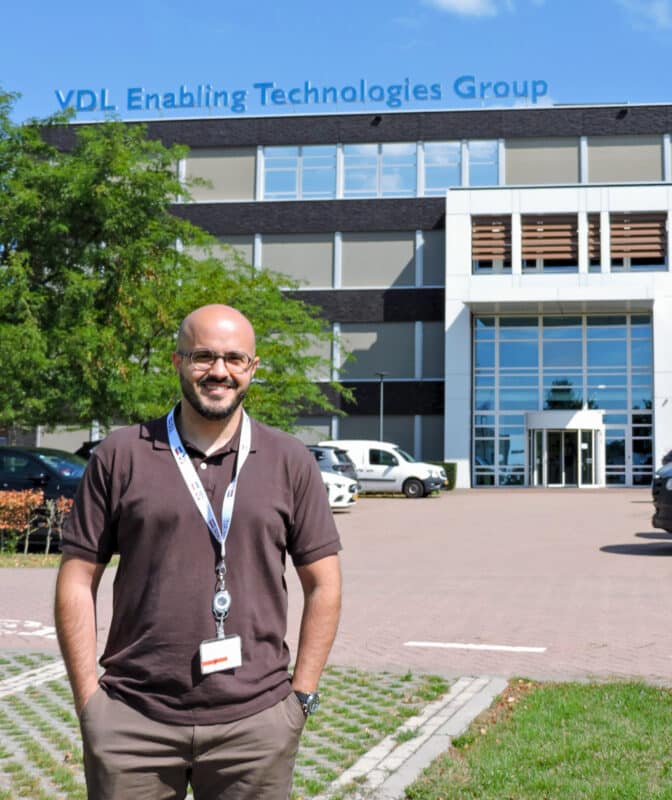
Newton Fonseca, electronics architect at VDL ETG T&D has been working at the intersection of these disciplines for the last four years. Originally from Brazil, he completed his PhD in Brazil and France before moving to the Netherlands.
“As an electronics architect, I bridge the different branches that stem from electronics: electromechanical engineering, electronic design and PCB design,” Fonseca explains. His work takes him through different stages of development, from defining a new system and building a proof of concept to solving integration problems and improving machines already in the field.
Thinking ahead
Working at different stages of development has taught Fonseca to think ahead: “A decision made while defining a system or building a proof of concept may cause difficulties much later, during integration, validation or production. So, in the design stage, you already need to think about this.” That requires an understanding of more than just the field of electronics.
Although he already had a strong theoretical background in systems engineering from the university, Fonseca wanted a more practical approach to developing complex mechatronic systems. In 2024, he followed “Mechatronics system design” parts 1 and 2 at High Tech Institute. The courses used examples from engineering projects to show how different disciplines interact and how choices can be assessed at the system level.
For Fonseca, that broad perspective was the main benefit of the courses. He doesn’t need to take over the work of a mechanical, thermal or control specialist, but he does need to recognize when a decision affects their part of the system. That makes it easier to raise the right questions and discuss possible solutions across disciplines.
Actuators
Where “Mechatronics system design” gave Fonseca a broad view of how the different disciplines within a complex system interact, his expertise lies in power electronics and control. “Actuation and power electronics” at High Tech Institute was a logical choice. He already knew trainer Adrian Rankers from “Mechatronics system design” and had been pleased with the way he combined technical depth with practical examples.
'You really need to understand the implications of the choices you make.'
“Within VDL ETG T&D we design actuators for high-performance systems, where the requirements can be very tight,” Fonseca explains. “You really need to understand the implications of the choices you make.” The “Actuation and power electronics” course examined those choices through actuator specifications, different actuation principles, power electronics and control theory.
A motor converts electrical energy into mechanical movement, but it’s only one part of an actuator. Engineers must first determine which actuator topology best suits the application. Depending on the required movement, force and precision, that could be a conventional motor or a different principle, such as a piezo actuator. Each option has its own limitations and can be optimized in different ways.
An actuator may generate heat, place new demands on the mechanical construction or make the control loop more difficult to optimize. “When you design an actuator, you have to keep an eye on how your decisions will affect the mechanical and thermal solutions,” says Fonseca. So, although “Actuation and power electronics” focused on one specific part of design, actuator selection was still approached as a system-level decision.
System architecting
All three mechatronics courses gave Fonseca more background for discussing design choices with experts from other fields and for recognizing when their input is needed. VDL ETG closely monitors these developments and empowers their employees to grow. “I haven’t locked anything in yet, but the Systems Architect(ing) training caught my attention,” Fonseca says. “That training would be another step toward understanding the complete development process, from the first definition of a system to integration, production and improvements in the field.”
The Mechatronics curriculum maps out every training in the program, showing the relationships between courses and their levels, so you can plan your learning path step by step.
Keep up to date
Receive our monthly updates

