


Published on:
18 September 2026
Author:

A developer of advanced production automation like IMS needs to have a solid grasp of the possibilities and limitations of the various components used in high-tech machines. Roy Kelder, R&D engineer at the Almelo-based company, decided to expand his knowledge of actuators by taking the course “Actuation and power electronics.”
When developing a new machine, it isn’t always clear in advance which technical solution will work. Especially when high positioning accuracy, vacuum or heat come into play, a developer of advanced production automation like IMS first has to define the possibilities and limits. As an R&D engineer there, Roy Kelder regularly runs into exactly these kinds of questions.
“Within IMS, we have roughly three technical departments: mechanics, software and R&D,” Kelder explains. “Projects are handled by software and mechanics, after R&D has looked at what’s needed during the preliminary phase. Because our customers are often at the forefront of technology with their products, what they want frequently needs further investigation. In those cases, a project team can bring in someone from R&D with the specialist knowledge the project requires.”
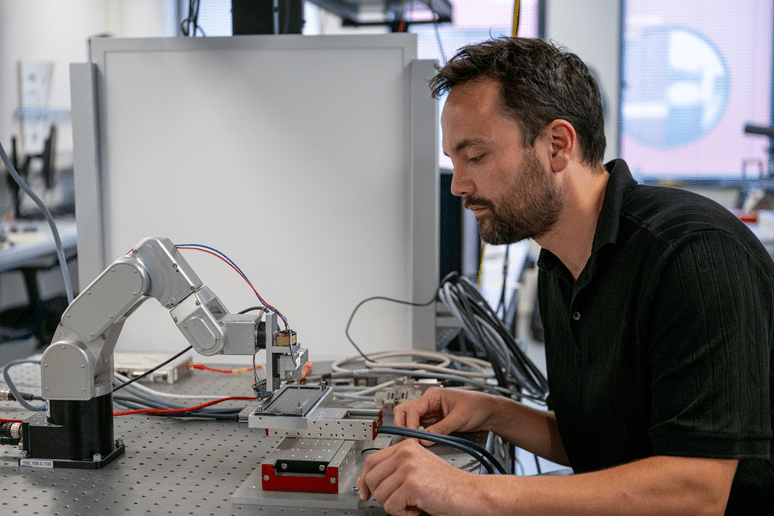
As an R&D engineer, Kelder supports a range of projects. He’s currently working on a proof of concept (POC) for a medical project involving pacemakers, as well as validating a brain drill and providing control engineering support for a smart industry project.
As a systems integrator, IMS generally doesn’t design the entire actuator itself. Instead, the company translates the machine’s requirements and the desired application into a suitable actuator solution. That’s not as simple as comparing a few specifications. Engineers need a solid understanding of how the various components behave under different conditions, especially when a machine pushes close to its technical limits.
Credit: Yuri Derks Fotografie
Lesser-known actuators
One example is selecting the right motor. Here, an engineer looks at the required static and dynamic forces and what the motion cycle will look like, among other things. Heat generation, control and feedback via an encoder or other sensors also factor in. On top of that, practical aspects need to be considered, such as available space, weight, environmental conditions, reliability and cost. “You might not design the motor yourself,” says Kelder, “but you do need to understand what’s behind it and where the limits lie.”
To expand his knowledge in this area, Kelder took the course “Actuation and power electronics” at High Tech Institute. It covered various types of motors and actuators, along with the associated power electronics. It also looked at how mechanical and electronic noise in the control loop can be accounted for to keep a system accurate and robust.
'It’s less intimidating to propose that kind of actuator, because I have a better sense of what I can do with it.'
The explanation of lesser-known actuators especially opened up new possibilities for Kelder. For example, since joining IMS, he’s worked relatively little with piezo actuators, which raised the threshold for including this type of actuator in a POC. Now that he understands better how they work and when they’re suitable, that’s changed. “It’s less intimidating to propose that kind of actuator, because I have a better sense of what I can do with it.”
Electrical discharge in vacuum was also covered extensively during the course. In a Townsend discharge, electrons can trigger an avalanche of new electrons, ultimately resulting in an electrical breakdown. This matters when selecting the drive voltage for actuators. The chosen voltage needs to be sufficient for the desired operation while matching the chamber pressure, the spacing between components and their geometry, to prevent unwanted electrical discharge or breakdown. The graphs and visualizations presented in the course gave Kelder a better understanding of this effect and of how the spacing between components influences it.
Credit: Yuri Derks Fotografie
Valuable
The course was taught by two professionals from the field. “Both of them had the hands-on knowledge to really dig into the subject,” says Kelder.
“Bart Gysen from Prodrive presented the physics of actuators using practical examples. “His subject-matter expertise really showed, and he was able to answer even difficult questions clearly and with solid reasoning.” Jeroen van Duivenbode from ASML focused more on power electronics. “He also clearly had a lot of hands-on experience, but from a different angle than Gysen.” Kelder found those practical examples especially valuable. “I would have liked even more of that.”
Not every part of the course was directly applicable. The simulations of magnetic fields in Python, for instance, were less useful for Kelder. Still, he says the knowledge could well come in handy for a future project.
Kelder had already expected the course to go into real depth, based on an earlier experience. In 2022, he took “Thermal effects in mechatronic systems,” also through High Tech Institute. That course centered on the effects of heat generation in different materials within a machine. There, he worked with a lumped-capacitance model in Python and Matlab, which makes it possible to calculate how heat spreads through a machine, how quickly components heat up and what the consequences are for the system early in the design process.
When a component heats up, that heat can transfer to surrounding parts and cause materials to expand. How significant that effect is depends on factors like the material, the geometry and the connections between components. The environment matters too. “In a vacuum, heat transfer through airflow is negligible, so conduction and radiation play a bigger role. Since IMS regularly works on machines that reach high temperatures, this knowledge is very useful in my work,” says Kelder.
Both courses proved directly valuable for Kelder’s projects. “Thermal effects” helped him see the bigger picture for an inspection machine he was working on at the time. From “Actuation and power electronics,” he was able to directly apply the theory around the Townsend avalanche. The course material also correlates well with control techniques he uses daily.
A possible next step for Kelder at High Tech Institute is “Advanced motion control,” though it’s not on the schedule just yet. “I want to let this knowledge settle in. After that, I’ll look at where best to spend next year’s training budget.”
The Actuation and Power Electronics training is available once a year.
Keep up to date
Receive our monthly updates

