


Published on:
06 July 2026
Author:

Software projects often bring together globally operating teams, parallel workstreams and technical dependencies within a single development process. Dries Moors, software project leader at NXP, recognises the importance of stakeholder management in aligning teams, priorities and interdependencies, and enrolled in a course at High Tech Institute.
In the high-tech industry, it is no longer the case that a single software team works on a single product. Within edge AI projects, for example, specialists in security, machine learning, connectivity and signal processing work in parallel on the same architecture. These are often separate teams which, at larger companies such as NXP, also participate in multiple projects simultaneously from different locations worldwide. For project leaders like Dries Moors, this means constantly switching between different stakeholders.
Moors began his career as a software engineer at Philips and moved with the semiconductor division when it was spun off as NXP. As a software project leader, he is now responsible for the timely delivery of the software components that go into a chip. NXP chips find their way into a wide range of applications. For example, the automotive industry is an important market: virtually every newly produced car today contains multiple chips from the company. Closer to Moors’ own area of work, they are also widely used in smart sensor solutions, insulin pumps and hearing aids.
Complexity
Especially in wearable products, chips need to be very small and must not draw too much power. After all, batteries for these devices are often smaller than a fingernail. That is already a challenge in itself, but current developments in machine learning (ML) and AI add yet another layer of complexity. “At the moment, the effort is to get this into a chip without requiring an entire external infrastructure,” Moors explains. “That demands very specific hardware with very specific software inside it. NXP is very good at that.”
'That’s why stakeholder management is so important. You need to know who has influence, what information someone needs, and when to share it.'
However, because NXP also wants to serve the mass market, it is important that the software can align with mainstream systems. This makes the projects in which Moors is involved highly complex. Within a single programme, he works with teams covering security, signal processing, connectivity and model optimisation, among others. “A large part of my time goes into aligning teams, resolving blockages and monitoring priorities and deadlines,” says Moors.
That is precisely where the biggest challenges arise. Different stakeholders each have their own interests, priorities and expectations of a project. Some are mainly involved on the technical side, while others want to keep track of planning, risks or dependencies in relation to other projects. When information is shared too late, or when stakeholders are unexpectedly confronted with problems, this can have major consequences for the project’s progress of a project. “A meeting can turn very quickly when people are caught off guard,” Moors explains. “That’s why stakeholder management is so important. You need to know who has influence, what information someone needs, and when to share it.”
Stakeholder management
Within projects, choices constantly need to be made. As a result, schedules change, new dependencies emerge and priorities shift. When stakeholders are included in good time on developments and potential risks, teams can prepare for what is coming and there is more room to adjust before problems escalate. When certain parties are not involved early enough, or don’t get sufficient visibility into developments within a project, risks arise. To get a better grip on this, Moors took the ‘Project Leadership’ training at High Tech Institute.
'Some stakeholders will come along regardless, while others structurally push back without actually having decision-making authority. Sometimes you have to accept that you can’t put all your energy into that.'
The course placed a strong emphasis on stakeholder management. “I had expected it to be one of the topics,” Moors says. “But almost the entire training was about it. That turned out to be a good thing, because it allowed us to really go in depth.”
According to Moors, the added value lay mainly in the practical implementations techniques. “How to map stakeholders, what information they need, and how to structure that, was all made very concrete.”
An important part of the training revolved around consciously selecting and prioritising stakeholders. After all, they do not all need to receive the same information or be involved equally. Moors: “You learn to look at who genuinely influences decisions, who mainly wants to be kept informed, and which relationships you should actively invest in.”
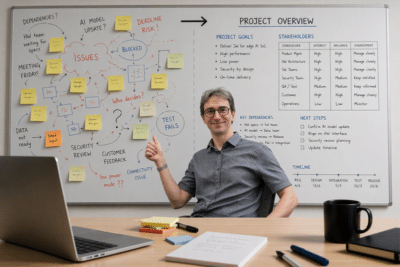
You can also deliberately choose to engage certain people less actively. “Some stakeholders will come along regardless, while others structurally push back without actually having decision-making authority. Sometimes you have to accept that you can’t put all your energy into that.”
The training, according to Moors, showed how to build in structure from the very start. The so-called project charter plays an important role here: documenting the boundaries, objectives and preconditions within which a project is executed. “That creates clarity about expectations,” he explains. “For yourself, but also for stakeholders.”
The course also strongly emphasised that stakeholder management should not only begin when a project runs into problems, but must be part of the approach from day one. Stakeholders must be properly identified, kept on board in the right way, and provide input in time. The course also helped structure this element “so that you don’t drown in the reporting lines you’re building up.”
Practical
Moors especially appreciated the focus on real-world practice. Trainer Wilhelm Claussen showed, among other things, how he himself has been structuring and following up on stakeholder information within projects for years. “I used to work mainly with loose notes. Following his example, I have been structuring much more deliberately. It makes things a lot less vague.”
The course also offered room for practical advice such as how to get started with stakeholder management, which tools are available, and what to do once you have a document in place. There was plenty of space for participants to bring in their own real-world examples, and because the group was relatively small, it was possible to go deeper into specific situations.
Although Moors says it is still too early to draw firm conclusions about the effects on his ongoing projects, he does notice a shift in his perspective. “I’ve become more aware of the importance of stakeholder management from the very beginning of a project,” he says. “You only notice later on in a project how many problems you’ve prevented by having the right people on board from the start.”
Recommendation by former participants
By the end of the training participants are asked to fill out an evaluation form. To the question: 'Would you recommend this training to others?' they responded with a 9.2 out of 10.
The training 'Poject Leadership (1 day)' is held twice a year in Eindhoven.
Keep up to date
Receive our monthly updates

