“Start with system functions and think beyond the boundaries of your own discipline”

High-tech development processes are becoming so complex that organizations cannot avoid thinking and working in a multidisciplinary way. After all, the ideal solution is rarely one-dimensional. However, collaborating engineers from different fields are only successful if they understand each other’s jargon. VDL ETG T&D sends its technology professionals to the Mechatronics system design training at High Tech Institute so that they can train that skill.

The mechanical engineering group of VDL ETG’s Technology & Development department currently employs approximately fifty people, of eight different nationalities. Group leader Bart Schalken notices the differences: “Education in the Netherlands is excellent and the knowledge level is very high. You can only see that clearly when you start recruiting internationally. I grew up in Eindhoven, so in my experience, this is the normal world. However, when you talk to international engineers, you notice how special the technical level is in this region. In the field of precision mechanics, our schools and universities are ahead of their international counterparts.”

'Mechanics may often be the basis here, but that doesn’t mean that you can meet all system requirements.'

Another point where Dutch engineers excel is that they’ve learned to look beyond the boundaries of their own discipline. This quality is becoming increasingly crucial. “Development processes are almost all multidisciplinary and so complex that you can no longer approach them sequentially; you have to move in parallel,” says Schalken. “Mechanics may often be the basis here, but that doesn’t mean that you can meet all system requirements. Then it’s important to involve another discipline. Only by connecting and working together can you ensure that the product will meet the functional requirements.”


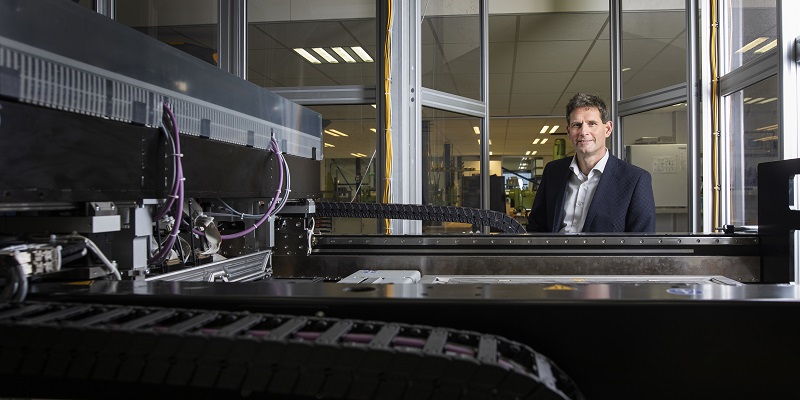
“You don’t have to know all the ins and outs of the other discipline, but you do have to master the basics,” says Bart Schalken of VDL ETG T&D. Credit: Bart van Overbeeke

But how do you find the right specialist within a group like Technology & Development that has grown from a few dozen to around three hundred and fifty since its inception eight years ago? To keep an overview and to ensure that everyone knows exactly who to contact, Schalken has carefully mapped out the sub-competences. “I’ve listed more than two hundred competencies and capabilities within mechanics and indicated per employee who has what knowledge. Those scores make it immediately clear who you should go to if you need knowledge about, for example, leaf spring constructions or vacuum systems,” Schalken explains. “Ultimately, the goal is to deliver the best result for our customers, but the know-how for the optimal solution doesn’t necessarily have to come from your project group or department. We make use of all the knowledge we have on board. And if there’s a hiatus, we always have our network of external partners and universities. That’s the atmosphere I want to create.”

Due to the increasing complexity and the urge for a shorter lead time, VDL ETG works with increasingly large project teams. “So the need for multidisciplinary collaboration is getting bigger and bigger,” Schalken experiences. “Normally, we’re in a large office space, but now, because of corona, we often work from home. That doesn’t make it any easier. Of course, we share the most important project information during digital meetings, but what’s missing now are the accidental conversations that arise at the coffee machine. While those are often the lubricant of smooth collaboration in projects.”

Eye-opener

A precondition for good collaboration is that engineers speak the same language. “You only seek each other out if you understand each other’s jargon,” says Schalken. “You don’t have to know all the ins and outs of the other discipline, but you do have to master the basics. Everything revolves around communication.”

To make the collaboration between the disciplines more effective and more decisive, at the beginning of last year, Schalken arranged for the High Tech Institute’s “Mechatronics system design” course to be given in-house at VDL ETG. Many of his people have now attended this training to gain a better understanding of adjacent disciplines. The course covers basic concepts and terminologies and the participants apply them to the disciplines around them.

“My group mainly consists of mechanical engineers, but such a course only really catches on when the other disciplines join as well. That’s why we invited people from the software, electronics and mechatronics groups. In addition to paying attention to theory, the training makes time to work together in teams pragmatically. That provides so much insight. Only when you look at a problem together, you really notice how they approach it from a different discipline. A real eye-opener.”

Although the follow-up process has been temporarily delayed due to the current corona measures, Schalken hopes that eventually most of his own group and as many engineers from other disciplines as possible will learn to speak the common engineering language. “In recent years, TU graduates have been given a broader base and have been trained to think and work in a multidisciplinary manner. For them, the Metron 1 training is no longer necessary and Metron 2 suits them better. That’s perfectly fine, of course – the great thing is that the added value is recognized,” Schalken states.

Start with the function

In addition to the training being an eye-opener for the participants, Schalken is counting on another advantage to become visible. “The core of VDL ETG is in system development, in combination with our manufacturing knowledge,” he explains. “Everything is under one roof. You can walk from the engineering department to the machining hall and the sheet metal shop. We have a lot of knowledge about manufacturability and value engineering. Helping and advising customers with DFX is where it all began. Today, VDL ETG itself is the development party and customers involve us starting from the specifications. We take care of the entire development process up to and including realization. As a result, customers only have one point of contact for the entire process.”


“Only when you look at a problem together, you really notice how they approach it from a different discipline.” Credit: Bart van Overbeeke

This approach means that VDL ETG engineers not only see the theory but are also closely involved in the manufacturing process, assembly and qualification of the end product. “The close connection between theory and practice ensures a steep learning curve for our engineers,” Schalken points out. “This knowledge is further enhanced because they get direct feedback on how the products are performing in the field. For example, we analyze parts that are returned after an update. Any weak links become visible and we take that knowledge with us to improve the next design.”

The mechanical engineers at VDL ETG focus a lot on DFX for series products in high-tech. “This knowledge is now well embedded within the organization,” says Schalken. “The next step is that we learn to think and work from the function of the system. What does the customer really want? What’s the question behind the question? And what roadmap is behind that?”

'The keys are communication and speaking the language of your colleagues from another discipline.'

Because VDL ETG has traditionally been quite focused on mechanical engineering – “our mechanical engineers are often the owner of a system” – the solution to a problem is quickly sought in that corner. “Ultimately, of course, you want to move towards a feasible and cost-efficient design – we’ve already laid that foundation – but the function of the design is the starting point,” Schalken states. “What does it take to make it happen? That’s the goal you must have in mind all the time. The mechatronic systems we develop focus on increasingly faster and more accurate positioning in an increasingly cleaner environment. What competencies do you need to realize such a position accuracy with those preconditions? You don’t have to come up with the solution yourself, but you must understand when to involve whom in the development to reach the end goal. The keys are communication and speaking the language of your colleagues from another discipline.”

This article is written by Alexander Pil, tech editor of Bits&Chips.

Recommendation by former participants

By the end of the training participants are asked to fill out an evaluation form. To the question: 'Would you recommend this training to others?' they responded with a 8.9 out of 10.

TUE PDEng answers the call to drive the future of industry

The link between industry and academia is crucial for preparing the workforce of tomorrow. As industrial leaders look to TUs for advanced engineers to fill leadership roles like that of a system architect, TUE’s PDEng program answers the call by infusing personal and professional development into students with training.

The Professional Doctorate in Engineering degree (PDEng) isn’t your typical advanced degree. In fact, the program is relatively unique to the Netherlands, with only a few other countries offering similar programs. PDEng’s Dutch roots go back several decades, but in 2003 the professional doctorate got its new name and was recognized by the Bologna Declaration as a third-cycle (doctorate-level) program. Different to a PhD, the curriculum doesn’t require years of research and a lengthy dissertation, rather it’s a two-year post-master’s program aimed at elevating systems knowledge and enabling the next generation of developers by gaining valuable hands-on experience and first-hand access to industry to become a system architect.

Each year, Eindhoven University of Technology (TUE) accepts 100-120 PDEng trainees across its various programs, spanning the fields of chemical, mechanical, electrical, software and medical engineering. “We have a very stringent selection process to ensure that our programs maintain an incredibly high level,” describes Peter Heuberger, the recently retired program manager for the Mechatronics and Automotive PDEng groups at TUE. “Just to give you an idea, each of my groups has only eight people. Those 16 spots were filled out of a pool of more than 200 applications that we received from all over the world.”

Peter Heuberger: “We’re looking to build advanced engineers that will take a few steps back and adopt a helicopter view of the problem.”

'Not only are they located in the neighborhood, but their extensive pool of industry-experienced engineers and experts greatly complimented our goal of getting our trainees as close to industry as possible'

Helicopter

As technology becomes exponentially more complex, success in technical development relies heavily on teams of multidisciplined engineers working together, each doing their part to contribute. A challenge, however, is that by nature, engineers tend to focus on one area and fail to see the big picture of the whole system. “Typically, if you give an engineer a problem, they’ll jump right in and start to unscrew bolts and take things apart, focused on finding their own solution to the problem,” illustrates Heuberger. “But we’re looking to build advanced engineers that will take a few steps back and adopt a helicopter view of the problem. Not just where the problem lies, but for whom is it a problem? Will it still be a problem next year? What are the costs involved? What’s the lifetime of the product?”

So, how do TUE’s Mechatronics and Automotive PDEng programs encourage their engineers to adopt this big-picture systems approach? They turn to training – especially in the first year. “A few years ago, while we were organizing system engineering courses at the university, it became clear that we didn’t have the resources or manpower to do all the necessary training in house,” explains Heuberger. “That’s when we reached out to High Tech Institute for help in providing training courses. Not only are they located in the neighborhood, but their extensive pool of industry-experienced engineers and experts greatly complimented our goal of getting our trainees as close to industry as possible.”

“After the first week of introductions, we have the trainees jump right into the Systems Thinking course. This is where many of the trainees get their first introduction and exposure to industry, the demands of the industrial plight and specific methodologies with which to approach system engineering,” says Heuberger. After the initial training, trainees spend the next several periods honing the methods and skills they’ve learned as they train their own system-engineering approach. “For this, we take on several sample projects, given to us by industrial partners like ASML, DAF, Philips and Punch Powertrain, where trainees take on different roles, ranging from project manager and team leader to communications, configurations or test managers. These exercises add more practical tools to the training and give trainees a better grasp of the bigger picture as they gain new perspective in the essence of their work.”

'This is precisely one of the most important aspects of training, the gained awareness and perspective'

Awareness

As the Mechatronics and Automotive PDEng trainees shift into the final module of the first year, TUE again reaches out to High Tech Institute to give a training on Mechatronics System Design. “This is a really high point for our trainees nearing the end of their first year, especially those interested in mechatronics. At this stage, they learn about advanced control theory from Mechatronics Academy experts like Adrian Rankers,” depicts Heuberger. “Something that really seems to stick with them is that you don’t always need very sophisticated control theory. You need to get the job done. When looking at a problem from a smart perspective, sometimes the most basic control theory is the best fit. But of course, it might be due to the control application or to the hardware setup, for example. This is the point where it all seems to click, and they really see the big picture.”

“This is precisely one of the most important aspects of training, the gained awareness and perspective,” adds Riske Meijer, incoming director of the Mechatronics and Automotive PDEng programs. “The awareness that when you’re starting any job, you’ve got to look beyond one task and one solution, at the job as a whole. That’s what it takes to be a successful system architect in industry.”

Riske Meijer: “You’ve got to look beyond one task and one solution, at the job as a whole. That’s what it takes to be a successful system architect in industry.”

Answering the call

Heuberger and Meijer will be the first to tell you, the TUE PDEng program doesn’t produce system architects but more of a system engineer. After all, there’s a big difference between leading groups of 3-5 people at university compared to leading groups of 30-50 in today’s workplace. To get to the level of a real system architect, it takes somewhere around 20 years of experience and development in the industry. However, by giving young engineers enhanced tools and real, hands-on industrial experience, TUE provides them a head start. Of course, not all trainees go on to become system architects, as not everyone is built the same. Many of them go on to find their place in other leadership roles like project management, people management or technical leads.

“Industrial partners have called on us to help produce advanced engineers beyond the master’s-degree level. They’re looking for young talent that will be able to step up as team leaders and in other leadership roles to advance the industry,” suggests Heuberger. “So that’s what we aim to do, we’re answering the call of industry and preparing future engineers, team leaders, project managers and system architects to fill those needs.”

This article is written by Collin Arocho, tech editor of Bits&Chips.

Recommendation by former participants

By the end of the training participants are asked to fill out an evaluation form. To the question: 'Would you recommend this training to others?' they responded with a 8.9 out of 10.
Training is key to superior chip knowledge at NXP

As the electronics and semiconductor domain continues to explode with complexity, engineers are having to step outside of their comfort zones and take on new roles to keep up with the increasing demands of chip performance. For semiconductor giant NXP’s failure analysis department, training employees and broadening its knowledge base is instrumental in holding the leading.

For nearly 25 years, Johan Knol has known exactly where he wanted to be. In 1996, fresh off finishing his master’s degree in electronics with a focus on analog design and semiconductor processing at the University of Twente, he had his eyes set on joining the semiconductor arm of Philips – which was later spun out as NXP. “I saw what Philips was achieving in the semiconductor industry at that time and it was quite impressive. But even then, it was extremely evident to me that the industry needed a major catchup, particularly in the analog-chip world,” recalls Knol, Manager of Failure Analysis for Security and Connectivity at NXP. “I came to Nijmegen to tour their cutting-edge MOS-4 fab, and it really piqued my interest. I knew this was a place where real innovation could be realized, and I wanted to be part of it.”

In his 25 years with the company, Knol has held several positions. First as a device physics engineer, then a process integration engineer – working to improve the overall process from development to manufacturing – before opting for a move to NXP’s failure analysis (FA) department. “I chose failure analysis because it combines all corners of NXP. Essentially, we work in a state-of-the-art silicon debug lab, where my group is responsible for identifying electrical failures within all the new products NXP launches and ensuring all of our products meet the highest quality standards,” describes Knol. “We help the design teams identify issues in the design and manufacturing chains. To do that, NXP provides us with top-of-the-line equipment to handle all the analysis requests, from mixed-signal processing technologies down to 16nm, and using techniques like laser voltage probing, laser frequency mapping and nanoprobing – we do it all.”

Evolving

One aspect of the silicon domain that Knol has encountered in his 2.5 decades in service is just how quickly the industry seems to be evolving. According to him, engineers, at least in his department, are having to go well beyond their areas of focus and broaden their understanding of NXP’s entire production chain, especially as chip complexity continues to explode. One essential tool he relies on to keep his team sharp: training and personal development.

“Almost no one comes out of university, or even from another department, having a solid grasp of the entire field at NXP. When someone joins our team, they’ve got to learn at least 4-5 different areas of the production chain,” depicts Knol. “It’s only with that knowledge that you can solve the kinds of problems that we get sent to us – ie a chip isn’t working, but with no clue as to why. Typically, new hires have a background in physics or chemistry or electronics, and maybe they’ll even have experience in analog or digital design but hiring someone with expert knowledge on mixed-signal design and these other disciplines doesn’t really happen.”

For Knol, however, it’s precisely this understanding of multiple aspects and disciplines that’s so crucial to the success of NXP’s FA lab, and why he’s a big believer in tech training. Knol: “Our competence program is primarily focused on broadening the knowledge of our engineers. They need to have a broad view of everything involved in creating a chip.”

'At NXP, we’ve had a shift from truly analog design to embedding digital more and more – so mixed-signal designs – and it’s happening ridiculously fast'

Digital transition

One driving force that Knol and NXP have experienced in the semiconductor sphere is the transition from analog to digital chips, or at the very least a combination of the two. “At NXP, we’ve had a shift from truly analog design to embedding digital more and more – so mixed-signal designs – and it’s happening ridiculously fast,” says Knol. “But even products that were 100 percent analog in the past, for good reasons, are now embedding more digital cores.”

Knol uses the example of NXP’s smart antenna solutions product line for 5G applications, where they used to deliver single RF transistors or RF low-noise amplifiers but now have started embedding digital content in that line of chips. “These chips are now much more complex, and the engineers that have spent years perfecting the analog design are now suddenly facing products with digital content. At first, they didn’t know how to deal with that, how to interpret that, or even how to test.”

That’s when NXP’s FA department reached out to High Tech Institute and arranged for an in-company session of the tech training “Test and design-for-test for digital integrated circuits” . “This shift to digital isn’t going to go away, it’s only going to become more prevalent. As a unit, we decided we needed to establish new competencies in this domain and this training was a perfect opportunity,” highlights Knol. “We chose High Tech Institute because of its undeniable link to the high-tech industry. They have a strong understanding of the domain because the trainers are actually from the industry. More importantly, we were able to work directly with them to tune the content of the tech training to our specific needs. That was the real strength that we saw in High Tech Institute.”


Time management

Of course, the success of any technology company depends on highly skilled and highly technical people. Sometimes, however, success can also stem from the soft skills of employees – such as good communication, stakeholder management and using time in the most efficient ways. But as the complexity continues to increase, and engineers are taking on more responsibility, sometimes the soft skills can be a challenge. “We have some really outstanding minds at NXP. Our engineers are some of the best in the world. But one thing we’ve found is that the most specialized technical people can often be lacking when it comes to soft skills,” Knol describes. “Efficiency being key in an environment like this means every day you’re being challenged to do more in your daily efforts.”

This can be a little tricky when trying to balance work, meetings, planning and the many personalities you encounter in the workplace. That’s why NXP adopted another tech training from High Tech Institute: “Time management in innovation.” “We saw that people were struggling with time management. To be honest, I was one of them myself. So, we took this training and made it a default course for our people – meaning at some point in time, everyone should take it. And it’s from personal experience that I can say this tech training is extremely helpful,” states Knol. “People came back from this course having learned new tools to embed better planning in their work, learning how best to establish boundaries and how to address the issues they face in communicating with others. So yeah, that has become another default module that we offer to our people. Time management, education, self-reflection, taking leadership and working in project teams on a global scale. These are the kinds of courses that have become quite important to us. We believe that by investing in these trainings to help our workers enhance their personal development, it makes us a stronger department within NXP.”

This article is written by Collin Arocho, tech editor of Bits&Chips.

Innovation and character light the path to IMS success

Interview with Martin Langkamp & Martijn Bouwhuis of IMS about system architecting
In today’s high-tech environment, companies of all sizes are looking to stay at the cutting edge of innovation. According to team leaders Martin Langkamp and Martijn Bouwhuis of Almelo-based IMS, the equation is easy. It comes down to a few key factors: keeping the employees interested, keeping the workplace light and focusing on personal development through training.

Dutch innovation in the high-tech sector comes from businesses of all sizes. While big names like ASML and Philips are recognized around the globe, there are also several small and medium enterprises (SMEs) in the Netherlands playing a big role in global high tech. Take, for example, Almelo’s IMS. IMS has been around for just over 20 years, opening its doors in 1999 after it was spun out of Texas Instruments through a management buy-out.

Now, in 2020, the automation and technology expert has delivered more than 750 production lines with an emphasis on the medical device, smart device and automotive domains. “We’ve grown a lot since the early days. Now, we see our role as helping our global customers realize their production goals,” explains Martin Langkamp, technical sales coordinator at IMS. “We do that by delivering our innovative machines all over the world that excel in the high-volume production of small, precise and sometimes extremely complex products.”

Character

While IMS’s global customer base is certainly large, the company itself has a relatively small footprint – employing more than 120 people at its Almelo and Groningen locations in the Netherlands. Despite its small stature, it’s having a big impact on consumer electronics. Currently, the high-tech machine maker is active in delivering machines used in the assembly process for the smart device and automotive sectors, in addition to next-generation headlights and sensors for cars.

“The character of IMS is that we’re always focused on innovation, not just locally, but globally,” highlights Langkamp. “That means we do a lot of international projects, which offers our engineers exciting opportunities to travel, learn and share knowledge. That’s part of our DNA.”

'We use education-based developmental plans in our evaluation process, to help people and the company meet our goals.'

Another focal point in the character of IMS is the focus on the personal development of its employees. “One of our main focuses is on continuing education for our workers. We find that trainings, workshops and conferences are a great way for our engineers to develop both personally and professionally,” comments Langkamp. “In fact, as we look to the future as we continue to innovate, the necessary competencies of a position can expand and the engineers may be guided to specific courses to bolster their skills. We actually use education-based developmental plans in our evaluation process, to help people and the company meet our goals.”

Modularity

Recently, IMS found a golden opportunity to utilize training. Looking to continue to grow and push the cutting edge of complex part manufacturing, the company took on a new role for its customers, helping lead them in the design of production machines by offering series-based machines, rather than one-offs.

“For many years, R&D operated more reactively for development, finding solutions for the customers as they arose,” recalls IMS R&D team leader Martijn Bouwhuis. “More recently, however, we’ve started to adopt new methods to become more proactive in the process and we’ve focused our efforts into making standardized products that can be tailored to fit our individual customers.”

To get these standardized products, IMS decided that modular thinking was the best way to achieve the new goals and it started laying the foundational work to get its workforce aligned on the idea. However, it was during the Bits&Chips System Architecting Conference, the team found that their modular approach fits perfectly with the principles of system architecting. Langkamp: “For a few years, we’d already been adjusting our processes, but we were looking for a better structure with more continuity within the whole of the company.”


According to technical sales coordinator Martin Langkamp, one of IMS’s main focuses is on continuing education for our workers. Credit: Fotowerkt.nl

'It was time to update and professionalize our working methods.'

Bouwhuis: “While we were assessing the best way to progress, we found that often in the design process we would focus on subsystems because that’s where the value was added. Somehow, we forgot to look at things from a system level. But as the complexity of the parts our machines are making continues to explode, it’s clear that software engineering has become more important than ever and it was time to update and professionalize our working methods.”

Rather than sending a few team members to a relevant training, IMS reached out to High Tech Institute to develop its customized in-company edition of the System Architecting training, allowing the Almelo-based company to bring in a broad and diverse group of its team. “It’s important in our transition to establish cohesion among all the different disciplines and departments,” says Langkamp. “From mechanical to electrical and software engineers to the sales team, the goal was to get everyone on the same page, thinking at a system level.”

Added value

“The reason we selected High Tech institute was because of the strength of its instructors. Their knowledge and expertise matched our needs precisely,” emphasizes Bouwhuis. “What we appreciated the most was that the trainers found ways to trigger discussion, which got our group of about 12 trainees really participating. This interaction between the team and the instructors, all with different perspectives, really enhances the training with a lot of added value.”


“This interaction between the team and the instructors really enhances the training with a lot of added value,” says IMS R&D team leader Martijn Bouwhuis. Credit: Fotowerkt.nl

Does IMS use training to attract or keep its skilled engineers? Is it difficult to compete with larger companies in the high-tech domain?

“Yes and no. Yes, training and education opportunities are a great tool to attract and retain our engineers. But, as far as competing or losing our skilled workers to the bigger companies, no, that’s not the case. In fact, I think the size of IMS, the scope of our work and our approach is something that draws people to us and makes them want to stay,” illustrates Langkamp. “In the Brabant region, it’s pretty common for engineers to bounce around from place to place, but here at IMS and in the Twente region in general, it’s just not as common.”

'Sometimes we refer to IMS as a high-tech playground for engineers.'

“Because we’re small, we’re able to keep things light and fun in the workplace. Of course, we’re extremely professional in working with our customers. But the people here are more than just a number and embracing that mentality means we can operate as a family and have fun,” adds Bouwhuis, joking: “Sometimes we refer to IMS as a high-tech playground for engineers.”

“Yes exactly. Because of our roots from Texas Instruments, we sometimes joke about having people working here for 40 years, but the company is only 20 years old,” laughs Langkamp. “By keeping our people interested with exciting projects, a light-hearted informal workplace
and a focus on our workers and their development, IMS is in a strong position to continue innovating.”


Photo credit: Fotowerkt.nl

This article is written by Collin Arocho, tech editor of Bits&Chips.

Recommendation by former participants

By the end of the training participants are asked to fill out an evaluation form. To the question: 'Would you recommend this training to others?' they responded with a 8.5 out of 10.

“The mechatronics curricula are very meaningful and relevant”

Testimonial Vinicius Licks about the mechatronics trainings of High Tech Institute
The Netherlands has long worked to put its stamp on mechatronics design and development. One way the country maintains its ‘Dutch approach’ is through trainings to transfer the knowledge. But how does that differ from other regions in the world? Vinicius Licks, professor of mechatronics at Brazil’s Insper College, shares what he observed attending Dutch mechatronics training.

With a rich history of technical innovation embedded in its culture, the Netherlands has long been at the cutting edge of technology and engineering. This advanced position stems, in part, from the robust relationship between industry leaders and the technical universities. However, another instrument the Dutch use to maintain a healthy high-tech ecosystem is through the utilization of courses and trainings to both transfer and preserve the knowledge. Now, as the Netherlands’ high-tech industry continues to hold its influence on global markets and supply chains, it should come as no surprise that the country’s expertise and skills within the realm are also of great international appeal.

Just ask Vinicius Licks, professor and associate dean of the mechatronics program at Insper College in São Paulo, Brazil. In 2018, Licks made his first of three long treks from South America straight to the Netherlands. He didn’t travel across the globe to enjoy a vacation; he came to get a feel for the Dutch high-tech environment, specifically through the mechatronics training cluster provided by High Tech Institute. “Training is one of the best ways to get in touch with new ideas and often to get new perspectives on old ideas,” says Licks. “It’s a great opportunity to communicate with your peers, exchange best practices and learn how to push the state-of-the-art in the field.”

Eye opening

Of course, coming from a setting in higher education, Licks was more accustomed to attending conferences, rather than technical training programs. “I work for an academic institution, so usually we’re the trainers, not the trainees,” he jokes. “But this was truly an eye-opening experience for me.” According to Licks, his first course, the “Motion control tuning” training, offered him a vastly different perspective on teaching and learning feedback control. “Most schools that I’m familiar with emphasize system identification in the sense that you must use it first to get a plant model to work with in your tuning efforts. The approach that I was exposed to during the training, however, was more experimentalist. The focus was less on the ‘modeling from first principles’ part and more on using frequency response estimates to tune the controller iteratively. While this approach to teaching feedback control was new to me, it was clear that for the control engineers in the Dutch mechatronics cluster, this was common sense.”

''The courses really helped me sharpen my skills and understanding of the Dutch cultural approach to mechatronics.''

Enthusiastic after completing his first course, Licks made the long journey across the Atlantic twice more in 2019, specifically for two more courses in the Mechatronics Academy’s training curriculum: “Advanced motion control” and “Experimental techniques in mechatronics.” “I was so impressed with the courses that I attended, they really helped me sharpen my skills and understanding of the Dutch cultural approach to mechatronics, both practical and theoretical,” highlights Licks. “The instructors were very knowledgeable and all of them professionally connected due to working or studying together in the past. That makes a big difference in terms of continuity and coherence of the content they’re delivering – all with the same vocabulary and experimental references.”

“The curricula are very meaningful and relevant. They’re completely designed for someone who wants to have a complete view of the field of mechatronics design. The sequence of courses is built in such a way that some frameworks will be dealt with continuously, but from different perspectives and with increasing complexity. This is very rewarding because you feel that someone has put in time and effort to really think about what’s included in every one of the courses,” depicts Licks. “It’s most likely, of course, that this is the work of many people and the outcome of several iterations of offering the same courses along the years, but also of caring to ‘close the loop’ with student feedback.”


Automation and Control Lab at Insper College in São Paulo, Brazil. Photo credit: Insper.

How were these trainings different from others that you’ve attended elsewhere?

“These trainings, in particular, have given me a different perspective about how feedback control theory can be taught and learned, as well as the importance of creating common project frameworks before sharing these frameworks with all your teams and making sure that every new team member will be well-versed in those frameworks as soon as possible. Coming from outside the Dutch cluster, it’s very interesting to realize how much shared knowledge there is in this industry in the Netherlands. People have been indoctrinated, in a positive way, into using the same conceptual tools and vocabularies, which makes the region much more productive. It’s amazing to see all these people getting so excited to look at an experimental Nyquist plot,” laughs Licks, “I’ve never seen such a fervent devotion to the frequency response function.”

Pragmatic

Another specific difference that Licks sees in the Dutch courses, versus others, is the style and format in which the training is presented. He says, of the several previous trainings he’s attended, they almost always fall in one of two categories: extremely theoretical or purely empirical. “Instructors coming from academia tend to be more prone to the theory, while typically, the industrial side is drawn the other way. What I experienced in the Netherlands was a methodology that mixed both worlds in such a way that theory was always informed by experimentation. You see that theory actually works in practice and you have a robust understanding of why this works because of the theoretical background. It’s this approach to teaching and learning that reflects much of the pragmatism embedded in the ‘Dutch way’ of doing mechatronics design.”

Do you have any plans to return for a fourth training course?

“As a matter of fact, yes. I’m looking forward to attending the ‘Advanced feedforward and learning control’ training. But I still have to convince the organizers to include additional sessions closer to the summer when the weather in the Netherlands is way more attractive!”

This article is written by Collin Arocho, tech editor of High-Tech Systems.

Hittech wants employees to drive their own success

IEMC for mechatronic engineers - Testimonial Stefan Vossen
Training programs can be an effective tool for any high-tech company to attract new talent and help employees sharpen their skills. To Development Manager Stefan Vossen of Hittech Multin, training courses provide something much more important – a chance to discover your intrinsic motivation and realize your passion. Hittech Multin organized the ‘EMC for mechatronic engineers‘ training in-company.

In 1994, Cor Heijwegen stepped down as a divisional director within the Hoogovens Group. The group consisted of numerous companies that supplied Hoogovens, now Tata Steel, with tools and materials used in the production of iron, steel and aluminum. On his way out, Heijwegen and a couple of colleagues decided to start their own business comprised of several of the Hoogovens suppliers, which was called Hoogovens Industriele Toelevering (Hoogovens Industrial Supply) or Hit Group. In 2004, it was incorporated as Hittech Group. Today, the corporation consists of eight self-governing, but not independent outfits, managed by a small holding company. By design, the companies are kept small, less than 100 people, to ensure flexibility, entrepreneurship and a focus on the customer.

One of Hittech’s subsidiaries, Hittech Multin specializes in the development and production of mechatronic products for the medical, semiconductor, measurement and analytical industries. These products are subject to high qualification requirements and are often associated with accurate positioning, optics, vacuum technology, cleanliness and medical regulations. To achieve this, the Hague-based Multin branch requires a staff with a strong technological background, as well as the desire to enhance skills through training.

'To work here requires the mindset and an urgency to constantly improve and the willingness to really engage with customers.'

“It’s no wonder that the majority of the development capacity of Hittech Group sits under the roof of Hittech Multin,” remarks Development Manager Stefan Vossen. “To work here requires the mindset and an urgency to constantly improve and the willingness to really engage with customers. That’s why so many of the technological advancements of Hittech are developed in, and with involvement from, this department.”


Stefan Vossen from Hittech Multin organized the ‘EMC for mechatronic engineers’ training in-company. Photo by Fotowerkt.nl

Philosophy

To maintain the customer-oriented focus, Hittech is continually looking to shake things up and employ out-of-the-box thinking to adapt and better fit its customers’ needs. After all, its mantra is “masters in improvement”. One tool the systems development company uses to ensure this is training. “I have a different kind of philosophy when it comes to training. I’ve noticed a number of times when attending my own courses, there’s a stark difference between those that are motivated to be there and others that are obligated to attend,” recalls Vossen. “The truth is, if you’re not intrinsically motivated to be there, you’re not likely to get anything out of it.”

Vossen himself started his career as a scientist at TNO, specializing in electromagnetism. While at the institute, he became interested in coaching others in their professional trajectories. “It was a rather steep growth track, but I attended multiple trainings on coaching. In these courses, I learned so much about myself,” illustrates Vossen. “That’s where I discovered that I really enjoy working with younger people and trying to help them further their career. That’s when I became a team manager and really found my passion for coaching and mentoring young talent. And ever since, that’s where I’ve tried to put my energy.”

Driver’s seat

Another aspect to Vossen’s philosophy on training is that there will never be a fixed course program in his group. Rather, training programs should be tailor-made to custom fit each member. “It really comes down to the needs of the person, of course, within their role on the team. I want to see them be enthusiastic about something and decide for themselves,” says Vossen. “I shouldn’t be in the driver’s seat of their career. That has to come from them, with their own vision and their own interests. I think taking courses is part of that.”

It seems like the approach is paying off. According to Vossen, over the last few years, product development at Hittech has been undergoing a transition. When the company was founded, the focus was on materials knowledge and construction principles, but now, it’s centered on moving mechanisms and mechatronics, combined with optics, electronics and software. “As a company, we’re offering fully integrated products. But with this transition, we’ve really had to intensify the systems engineering within the group,” expresses Vossen. “This shift meant we needed to adapt and improve our capabilities and I had a number of our engineers requesting to enroll in training courses.”

ROI

Recently, there was such an interest in an EMC training course that Hittech decided to commission a company edition of High Tech Institute’s “EMC for mechatronic engineers”. “When we select training courses, we don’t want a standard, textbook type of course. It’s important for us to find trainings that are taught by people with deep roots and experience in the high-tech domain,” highlights Vossen. “That’s really why we turned to High Tech Institute. Their trainings are designed for the industry by experts in the industry. It gives me a great level of comfort when arranging these kinds of trainings, as I know the content is always reliable.”

A training, however, is meaningless if it doesn’t lead to results, and of course a return on the investment. Though this can sometimes be difficult to quantify, for Vossen, the data is clear. One specific place he’s noticed marked improvements is in the early stages of system design. Vossen: “I’ve seen that our engineers often come back from training with a fresh new perspective. I notice this particularly in the beginning stages of project planning. For example, in the process of setting up error budgets, the engineers are taking more details into account, specifically with an eye to possible EMC-related issues, very early on. In the past, however, they might have missed these potential issues altogether.”

“Another benefit that I attribute to my employees participating in training programs is that it seems to help foster communication. Specifically, between those working in groups that consist of engineers from the various disciplines. They seem to understand each other’s needs better and hence take each other more into account from the start. And while no project is perfect the first time around, the better your specs and conditions are at the beginning of a project, the better and smoother the project is sure to go.”

This article is written by Collin Arocho, tech editor of Bits&Chips.

Recommendation by former participants

By the end of the training participants are asked to fill out an evaluation form. To the question: 'Would you recommend this training to others?' they responded with a 8.3 out of 10.

90 years of sensing and control – and now machine learning

Skillsets training - Testimonial from Omron
Driven by the needs of society, Omron has spent nearly 90 years developing innovative technologies to enhance people’s daily lives. According to the company’s European R&D manager Tim Foreman, this takes a commitment to keeping employees challenged and motivated by helping them enhance their skillsets with training. High Tech Institute provided a mixture of its soft skills & leadership trainings.

Perhaps you’re not familiar with Omron, but one thing for certain, you’ve benefitted from its technology. From its first innovation of accurate x-ray control timers, to the magnetic strips on credit cards, early ATMs and digital blood pressure monitors used at doctor’s offices – the company has been at it for more than eight decades. “Our philosophy has always been, to create value based on the needs of society,” describes Omron’s European R&D manager, Tim Foreman. “Society changes, and we’re continuously adapting to find innovative solutions to newfound issues. That’s what keeps us at the leading edge.”

Employing some 40,000 people around the world, Omron has received numerous recognitions, including a spot on the Derwent Top 100 Global Innovators by Clarivate Analytics and a top ranking on the Dow Jones Sustainability Index, which uses several indices to track sustainability efforts by publicly traded companies. “To make it on these lists is a great honor for us at Omron,” expresses Foreman. “It shows that not only are we among the innovation leaders in our field, but as a company, we keep our focus on the environment and do it in a smart way.”


Photo by Vincent van den Hoogen.

Tsunagi

Originally known as Tateishi, the Kyoto-based Omron has built its foundation on two key technologies: sensing and control. For instance, remote control devices in automobiles that detect your proximity to your vehicle, before automatically unlocking the doors as you get within a close distance. “It was these electronics components, the switches and relays inside of devices, that really got the business going,” explains Foreman. More recently, as technology has advanced, the company added a third core focus, referred to as “think,” aka machine learning.

The spotlight, however, isn’t simply on developing individual products, it’s about providing outstanding customer service. Behind the core technologies of Omron is for example the service known as Tsunagi – a Japanese word that translates to “filler”. “Tsunagi means that in your house, if you find a crack in the wall, you fill it in and repair it,” illustrates Foreman. “In the electronics business, it’s common to source parts from different vendors. Perhaps you choose Omron’s IPC, but another company offers you a highly specialized sensor that you need. The two parts should be compatible, but sometimes the user will get an error message. Rather than place blame or leave the customer to contact others, at Omron, we look to fill in the cracks. We tell our customers, no matter the issue, call us. We’ve put together some 400 small manuals to make systems work seamlessly and to provide expertise in interoperability – that’s tsunagi.”

Stakeholder management

With a portfolio of more than 200,000 products, Omron’s focus on interoperability and integration is a crucial part of the business. Not everything can be perfectly integrated, and when you’re dealing with different global offices, that can get tricky. An example, a safety sensor developed in Italy needs to work seamlessly with a control device developed in the Netherlands. This relies heavily on the communication abilities between the groups. “If the two sides fail to talk, it becomes immediately clear to our customers,” says Foreman. “That’s why we place a real emphasis on communication during the entire development of new products. When things are seamlessly integrated, our customers can clearly see the benefit of what we offer.”

'In the high tech world, conveying your message effectively is an essential piece to the puzzle.'

To achieve enhanced communication between units, Omron’s R&D manager turns to trainings and courses. “We have some incredibly bright employees at Omron, all of them very technically gifted, be it in software, mathematics or electronics. But while their technical skills may shine, it’s a much smaller percentage that also have strong social skills,” clarifies Foreman. “While especially skilled, our engineers sometimes don’t have the tools or experience to effectively convey their message. In the high tech world, that’s an essential piece to the puzzle.”

“You have to know how to sell your story and motivate others on the team. Furthermore, when you know you’ve got a good idea, you need to know how to approach upper management and convince them. It’s all about stakeholder management – a very expensive and very important term,” continues Foreman. “That’s why we turned to High Tech Institute to help us create Omron’s Talent Academy Training. They speak the right language; they understand the ecosystem and help give our boys and girls the tools to greatly improve on these skills and others.”

Motivation

This isn’t the only benefit that Foreman sees with training his employees. “It’s really just a question about how you keep talented workers, especially in the competitive high tech industry. The answer is simple: you’ve got to keep your people motivated. But how do you do that? Of course, you start by giving them a good salary, but that’s not enough. It’s done by giving them interesting challenges that apply to real-world issues and offering them state-of-the-art tools, equipment and training to tackle these issues,” claims Foreman. “It’s about creating a working environment where they can have fun and enhance their personal knowledge and skillsets. When these criteria are met, it shows in the final product and ultimately, improves its popularity on the market. What better motivator is there?”

It’s precisely these efforts to retain its talented workforce that are perhaps more telling than the total number of workers employed by the electronics company. At Omron, there are some workers that have been with the business for more than 30 years already. “These people have spent thousands of hours with their machines. They can be 10 meters away from them, hear an unusual noise and instantly know what the problem is,” boasts Foreman, himself a 26-year employee of the company. “But to be perfectly honest, that’s not a modern practice anymore. Nowadays, employees want to get a variety of experience – to try a little of this and a little of that.”

Omron’s solution: offer its employees broad access to various trainings for individual improvement. At the same time, the company works in-house to develop and apply computer learning models that allow machines to learn from the experienced operators. “The machines can then fill in the gaps and help guide a newer generation of operators,” suggests Foreman. “That’s the sort of technologies we’re currently working to develop at Omron.”

This article is written by Collin Arocho, tech editor of Bits&Chips.

Building a foundation for the Dutch high-tech ecosystem

Consultative selling training - Testimonial from NTS
Despite competition from China and the US, the Netherlands continues to play a major role in the world of high tech. Patrick Strating of NTS believes it starts with high-tech companies that have close ties to top-notch technical universities and continues with ambitious workers that thrive on life-long learning through training. NTS organizes the Consultative selling training from time to time.

Roughly five years ago, NTS started on a new mission: to become a leading supplier of machine equipment for the world’s top OEMs. In order to achieve this, the Eindhoven-based company set out on a series of acquisitions to bring in all the necessary expertise and abilities to build high-precision parts, equipment and machines. “Our aim is to function in the state-of-the-art domain and beyond, where technology boundaries are pushed,” explains NTS’ Technology Manager of Development & Engineering, Patrick Strating.

With this ambitious plan, however, comes a unique set of challenges to overcome. As NTS grew, it was composed out of a number of individual satellite locations, each with a different focus and expertise – which can be difficult when trying to build a cohesive team and vision.

“Ours is really a story of integration. NTS has been built up from separate entities. They were suppliers of frames and sheet metal, suppliers of precision metal parts and several engineering units of different kinds,” describes Strating. “To become an integrated equipment supplier, you need to master the complexity of the entire development and manufacturing chain. That requires much more than just skilled people executing supply chain work or doing machining on metal parts; there’s a need for employees who are fully technology-savvy and context-aware, and who can work with complexity while maintaining an eye on what our customer wants.”


Photo by Vincent van den Hoogen.

Proactive

Realizing the task at hand, NTS adopted a two-step solution. First, educate its workers from both the company and customer perspective of the new reality of being a first-tier supplier of specialized systems. Second, look to the labor market to find emerging talent with modern skills. “To understand the complexity of the machines, we needed a gradual buildup of both training of existing people, as well as attracting new people with more advanced multidisciplinary skills and a passion for life-long learning,” highlights Strating.

“At NTS, we offer a robust employee training program with individual coaching, technical mentorships and training. In addition, we have programs to stimulate craftsmanship at our manufacturing sites. We see it as a necessity to offer extensive training because it gives our employees a sort of basis or foundation in technical areas. But our true hope is that it also inspires them to continue broadening their scope, continue learning and to keep moving with our customers. We work with challenging companies like ASML, Philips and Zeiss, so it’s imperative that we’re keeping up to speed with them and even helping guide them with our expertise.”

To establish and preserve their expert knowledge, the workers at NTS often attend technical trainings in optics, mechatronics and systems development. Perhaps somewhat surprising, however, is the benefit the company sees by emphasizing social trainings like soft skills and sales. “Take the consultative selling for technology professionals training. That’s really about understanding your product and how it relates to the customer’s needs and values,” Strating illustrates.

“It’s been a part of NTS’ migration. Five years ago, as a supplier, we were more in a reactive mode. A customer would come to us with an issue and we would spend a lot of time in discussion to fully understand what was needed. Now, we can be more proactive. We go to work with our customers and really trying to elevate knowledge and innovate alongside them. Having a sound systems engineering basis and speaking the same language as our customers allow us to bring our manufacturing expertise to the table. In the end, our customers want critical equipment to be delivered, and our broad-based yet detailed manufacturing expertise is our key asset.”

Would you say that training is a tool for staying ahead of your customers?

“Not necessarily. For some trainings, that might be true. But for the more conventional courses, like mechatronics or systems engineering, what’s really needed is to establish a common base. Our engineers need to speak the same type of language as our customers,” expresses Strating. “You find that there’s this sort of specialized lingo and common approaches to issues in our industry, and this is really where the value is in technical training. But this doesn’t just serve NTS, it serves the entire high tech ecosystem of the region.”

Competitive

Strating believes the Dutch way of working is a real point of differentiation compared to other regional ecosystems. To him, the Netherlands and Belgium are very connected, communicative, competitive and collegial. “More or less, we depend on one another because we all supply each other. Of course, we can be competitive, but in the end, we’re all working with the same customers and they benefit from the cooperation and alignment of their suppliers,” says Strating. “Dutch companies are continually exchanging ideas, best practices and personnel. We find that if we continue to do things better if we share a common language in terms of technology and engineering methods, and if we have common people that demonstrate agility to address gaps within our ecosystem, it helps us compete with larger-market supply chains in China and the US.”

'High Tech Institute has strong roots within these universities and is able to incorporate modern technology approaches in their high-quality, professional and technical trainings.'

In describing how the culture of Dutch high tech was built, Strating points to the role of the technical schools. “I think the three technical universities form the high tech basis in the Netherlands. They’re responsible for shaping our future innovators and providing them with the common building blocks to succeed in this industry. I think as companies, it’s important that we continue to recognize that, but also work with these institutions in various forms of industrial cooperation,” voices Strating. “That’s one reason we turn to High Tech Institute for training. They have strong roots within these universities and are able to incorporate modern technology approaches in their high-quality, professional and technical trainings. That’s an important criterion for us.”

Flexible

Looking ahead to the next five years, NTS’ ambition is to use its expertise to lead the way in combining high-tech engineering with manufacturing. This will require highly trained workers that can understand not only the customer’s needs and challenges, but also have the ability to go through the engineering cycle and connect customers with their roadmap, all the way to the end-user.

“We want to bring together the worlds of customers, technical people and high-precision equipment. This will require incredibly talented and creative workers that are willing to really stretch technology to bridge the gaps. Those people are not so easily found; they have to be developed and that’s what we believe training and coaching help us achieve,” states Strating. “Training courses are important pieces of the puzzle. They’re instrumental in creating those flexible people that have a technical mindset and want to make a difference by understanding and optimizing this entire chain. That’s where we want to excel. That’s how we will grow the NTS market position as we look to be the best at playing this complicated global game.”

This article is written by Collin Arocho, tech editor of Bits&Chips.

Recommendation by former participants

By the end of the training participants are asked to fill out an evaluation form. To the question: 'Would you recommend this training to others?' they responded with a 9.1 out of 10.

Opto mechatronics in Eindhoven is top notch

Mechatronics courses - Testimonial Technical University Denmark
Eight years ago, DSPE started a certification program for training programs in the field of precision engineering. Three years ago, Nikola Vasiljevic was the first to meet the requirements of a bronze certificate. The mechatronics courses he took during his promotion had a great effect on his career.

In 2011, the Dutch Society for Precision Engineering (DSPE) took the initiative for a certification program for postgraduate education. The aim was to strengthen the offer by certifying training courses in precision engineering. The initiative arose when two years earlier, the Philips Centre for Technical Training was discontinued and the educational programs fragmented, partially disappearing. The Dutch high-tech sector could not afford such a loss, according to the industry organization.


Nikola Vasiljevic did his PhD research at the Technical University of Denmark. He designed, developed and tested a mobile, long-distance infrastructure for atmospheric and wind energy research.

DSPE decided to map out the entire range and monitor its quality by setting up a certification program. Candidates can attend certified training courses, for which they earn points (approximately one point per course day). A total of 45 points would yield the title of Certified Precision Engineer (CPE). This was later split into a bronze certificate for 25 points, silver for 35 points and gold for all 45 points.

In 2016, Nikola Vasiljevic was the first to reach the bronze level. The Serbian researcher obtained a PhD at the Technical University of Denmark (DTU) in the Department of Wind Energy. He designed, developed and tested a mobile, long-distance infrastructure for atmospheric and wind-energy research. His system, known as the Wind scanner, is based on multiple scanning wind lidars used to map the wind flow.

Vasiljevic’s background lies in electrical engineering and computer science. For his PhD project he was looking for a good course that would provide fundamental and practical knowledge about motion control tuning. He felt he lacked knowledge about a number of the practical aspects of his work. By chance, he got to know the mechatronics courses of High Tech Institute.

Travelling to Eindhoven was a long shot

High Tech Institute offers the vast majority of CPE-certified courses. Vasiljevic’s main reason for joining his first course was the way the subject was presented. “For opto mechatronics, there is a lot of literature available, but it is difficult to use it in practice,” he says. “Most of the courses I have taken now have focused on the practical aspects of designing complex opto mechatronics devices. That’s how I always learn, ie by building things and understanding them in practice. For more detailed knowledge I read books and professional literature.”

Because he knew the position of the Eindhoven region in the high-tech industry, Vasiljevic took the gamble and enrolled for the first course at High Tech Institute. “Opto mechatronics in Eindhoven is top notch compared to the rest of the world. Many of my electrical engineering friends from the University of Belgrade came to Eindhoven to obtain a PhD or to work at Philips,” explains Vasiljevic. He thinks the high-tech industry in Eindhoven is very healthy. “You don’t often see such a degree of exchange between different companies. People regularly move between companies within the region, thus contributing to the exchange of knowledge. Despite the competition, there is also a certain degree of openness.”

Balanced

Motion control tuning, the first course Vasiljevic took, was a great experience. “I was amazed at the knowledge I gained in those six days. The course was a balanced mix of theoretical and practical aspects of motion control tuning. That is what led me to go further and look at other courses, such as Advanced motion control tuning,” he describes.

After that first course, Vasiljevic followed a number of additional mechatronics courses. “There were other mechatronics courses that appealed to me, such as Experimental techniques in motion control tuning and Metrology and calibration of mechatronic systems. My background is in measurement techniques, the development of wind sensors and metrology, so almost the entire curriculum applied to my subject,” Vasiljevic highlights.

At his own university in Denmark, Vasiljevic would probably have had to take a full semester course to acquire the necessary knowledge. Moreover, he feels that the practical aspects cannot be taught by ordinary academic professors. “The teachers at High Tech Institute have years of experience in the industry. They have built up practical knowledge, supported by theory.” DTU required Vasiljevic to earn points for the European Credit Transfer System (ECTS). “I could use the CPE courses for that.”

The next course Vasiljevic took was the Opto-Mechatronics Summer School. He had just received a grant from the Marie Curie scholarship which offered sufficient funding for five additional courses, covering nearly all the remaining subjects of opto mechatronics, with the exception of software development.

Knowledge and networking

After his promotion, Vasiljevic hoped to create a second generation of the long-distance Wind scanner system. Unfortunately, that did not happen. Nevertheless, the courses have yielded him a lot. Especially in the networking part of the courses. “I became friends with Adrian Rankers and Pieter Nuij, both teachers at High Tech Institute. We keep in touch on a regular basis.”


Vasiljevic about his first training at High Tech Institute: “I was amazed at the knowledge I gained in those six days.”

In total, the investment was comparable to what you would need for an MBA degree. “It’s a fine testament to your abilities.” That being said, Vasiljevic thinks he has not yet managed to make full use of the knowledge he has gained because he has not created the second generation of his tool. “Still, I’ve improved the device with all the knowledge I’ve gained.”

After his promotion Vasiljevic considered looking for a job in Eindhoven, but in the end, he didn’t find a good match. “HR departments like to have standardized people who come to work in their company. Because I do things differently, from software development and optics to control and data science, far beyond the role of a narrow specialist or a system architect, it is difficult to label me and place me in pre-defined business templates,” illustrates Vasilijevic.

'That's why I think researchers today are more capable and better able to adapt than preformed R&D engineers, who are favored by HR managers.'

Currently, Vasiljevic is still working in the research world. “Being part of a research environment, especially in the field of technology and engineering, requires that you constantly build up new skills and knowledge because it is the only way to survive in a landscape where funding is scarce,” depicts Vasiljevic. “That’s why I think researchers today are more capable and better able to adapt than preformed R&D engineers, who are favored by HR managers.”

European expansion

Vasiljevic finds it difficult to identify a single aspect of CPE certification that is most valuable to him. “I’d say, it’s a mix of everything. Practical knowledge, which is a good basis for continuing to learn. Working in groups of up to twenty people and getting to know the teacher. Networking between colleagues.”

He is convinced that the ECTS credits he received from his CPE training have influenced his career in an extremely positive way. “I’m about to become a senior researcher. Also, in the Wind Energy department, I am considered an optomechatronic and the go-to person for problems with movement systems.”

Looking ahead, Vasiljevic wants to use his experience in opto mechatronics in such a way that one day he will take on a role as system architect and designer of new and exciting opto mechatronics. My main concern is that if I don’t use the knowledge I have gained, it will eventually evaporate,” he expresses. “Maybe one day I will work in Eindhoven, in the heart of the high-tech industry.”

The CPE certification program is currently being extended to the European level. Together with Euspen, the European equivalent of DSPE, some courses from other European countries are now also certified.

This article is written by Jessica Vermeer, tech editor of High-Tech Systems.

If you already know everything, how will you ever learn something new?

Design patterns training - Testimonial Thermo Fisher Scientific
In the midst of a tight Dutch labor market, companies are working harder than ever to keep and attract new talent. Thermo Fisher software manager Reinier Perquin believes that providing his employees with training opportunities not only helps bring in new personnel, but it also keeps his people fresh. He organized the ‘Design patterns and emergent architecture‘ training for his team.

Thermo Fisher Scientific, a multinational leader in biotechnology product development, employs more than 70,000 people around the world. But how does a company, with such a large global footprint, manage to keep its workers and continually draw in new employees? According to the software group manager from Thermo Fisher’s Eindhoven offices, Reinier Perquin, the main attraction for engineers is the opportunity to work on cutting-edge projects. An example: using advanced software to help solve the problem of global diseases. To get these talented engineers on board, Perquin says investment in training – both technical and social – is a valuable tool.

'Training budgets are increasingly important to attracting prospective colleagues.'

As a manager within the Thermo Fisher R&D department in Eindhoven, Perquin is routinely interviewing to bring new faces to the software group. What he’s noticed in these meetings: training budgets are increasingly important to attracting prospective colleagues. “In some interviews, it’s one of the first questions that people will ask. We’re seeing that more and more. While we don’t offer individual training budgets, we understand how important it can be, so we have a group budget specifically to encourage our employees to utilize training opportunities,” explains Perquin.


Photo by Vincent van den Hoogen.

Do you prefer internal or external training?

“We offer both to our employees but getting an outside view can be very helpful and that’s why we encourage external training. Our workers can gain new insights and learn about emerging technologies and cutting-edge methods. In my department, we’re seeing that the whole architecture of software is evolving before our eyes. Before, it was closed off but now you see things happening in the cloud or edge computing. That happens because new technology enables that. In software, you must constantly learn and adjust. So, if you don’t invest in yourself, then, in the end, you stand still. These trainings are a great method to enhance skills and learn about novel solutions.”
The ‘Design patterns and emergent architecture’ training took place in-company.

What’s the greatest benefit of offering your employees training?

“Well, first of all, people are really busy with their day-to-day tasks. Sometimes it’s good to step outside and take a break from thinking only about your work. It gives people the opportunity to not only get a break from their daily challenges but to focus on enhancing their personal skill set,” describes Perquin. “Also, it gives our engineers the opportunity to meet people from other companies and build a social and professional network. If people sit still too long without training – especially externally – they start to think in certain ways within their comfort zones. For some problems, you need to think outside of the box – not in absolutes like, ‘We’ve always done it like this, so we’ll continue to do this like this’. That’s the wrong mentality. Trainings help to disrupt this way of thinking.”

What type of courses are your workers choosing?

“Being in software, we often see our employees opting for training in design patterns in emergent architecture, taught by Onno van Roosmalen at High Tech Institute. In software, you see a repetition of certain patterns. By giving these patterns common names, essentially creating a unified software language, our engineers can better communicate and solve problems. Onno and I have a long history, going back to university, so I know the level of the knowledge that’s being taught and that training is easy to approve for our employees.”

Are there any other trainings you utilize?

“To be honest, we probably spend most of our budget on the soft-skills training – probably more than the technical trainings. Sometimes when people come straight from university, they tend to think that they know everything. Technically, these people can be very strong but often their soft skills are their weakest spot. Everyone wants to believe they’re system architects but I always say, an architect is not a technical person. In that situation, soft skills are more important than the whole technical level. If you already know everything, how will you ever learn something new? Sometimes they don’t realize it and they need time for reflection. That’s something the soft-skills training is incredibly helpful with.”

Do you notice a return on your investment? Does it help output? 

“Absolutely. I don’t see it as we’re losing three days of work; I see it as a worthwhile investment, both for the company and for the individual. I believe it helps in terms of productivity, especially the soft skills. We see very positive changes because people realize that if they want to achieve something, they may need to adopt a different approach. We see that trainees come back communicating ideas more clearly and working better with people and it makes them a far more effective employee. We find that our colleagues come back with new ideas, new energy and new inspiration. It keeps people fresh.”

This article is written by Collin Arocho, tech editor of Bits&Chips.

Recommendation by former participants

By the end of the training participants are asked to fill out an evaluation form. To the question: 'Would you recommend this training to others?' they responded with a 8.8 out of 10.