
Once electronics move beyond the prototype phase, the focus shifts from functionality to predictability and robustness. Electromagnetic compatibility (EMC) is then no longer an afterthought. That was reason for Dylan Gybels of Magics Technologies to delve deeper into this topic through a training at High Tech Institute.
“Electromagnetic compatibility (EMC) is less important in a prototype phase,” says Dylan Gybels, Electronic Engineer at Magics Technologies. “Problems in this area can often be solved later. But in series production or customer applications, taking EMC into account at an early stage prevents costly corrections later in the process.”
A solid EMC design prevents interference signals via power supply, cables or PCB layout from affecting other systems. “Performance can be temporarily reduced, but at least you won’t be blowing any fuses.”
Magics, a growing chip design company based in Geel, Belgium, is making such a transition toward product development. This created a need for more knowledge about EMC during the design process, so that the chips they develop are ultimately compatible with the equipment they are connected to. In the end, the equipment must be validated. “For these projects, we need to know how much current we emit and receive in relation to the coupling with other equipment. So we have to test for this.”
Magics employs staff from a variety of technical backgrounds. Despite that, knowledge about EMC was limited. “In regular technical education, the subject appears seems to come up,” says Gybels. “So someone had to dive into it. Since I am a point of contact for several projects, it was logical that I would take this on.”
Theory and reality
After a quick search on the internet, Gybels realized that just basic knowledge would not be sufficient for Magics. He was surprised that just across the border, in Eindhoven, High Tech Institute offered a four-day training called EMC Design Techniques. The training starts with basic knowledge and then moves on to advanced topics, such as designing and testing wired handlebars, filters and electrostatic discharge (ESD). That combination is what attracted him.
'By applying a few simple rules, many EMC tests become achievable, which allows the communication between devices using our PCBs and other equipment to run more smoothly and with less interference.'
For four days, Gybels and the other students were immersed in the different aspects of EMC design. “The theory was substantiated with practical examples,” Gybels explains. “The teachers brought a lot of industry experience. They knew exactly what engineers on the work floor need. They had demonstration setups that we could experiment with ourselves, so that the material really stuck.”
Gybels cites a case involving electromagnetic field couplings (EFC) on printed circuit boards (PCBs). Their chip must be able to communicate with other devices via a cable, and he looked for the right filters to limit the influence of EMC on this communication. With the knowledge from the training, Gybels was able to perform specific calculations for these EFCs, after which his team could redesign the PCB, with the right components already in place.
One thing that specifically stuck with Gybels is the explanation of decoupling on a PCB. “I had learned that you should place different decoupling capacitors on a PCB as filters to be able to handle various voltage spikes. Due to the greatly reduced equivalent series resistance (ESR) and equivalent series induction (ESL) of modern capacitors, the effective frequency range has broadened. That means a single high-value capacitor can often be more effective than multiple smaller ones in a row.”
Gybels also remembers discussions on filter design for inputs and outputs, the mechanism behind electromagnetic field couplings, and how ESD behaves in practice. The latter stood out because ESD is often somewhat overlooked. “We do wear protective clothing in the lab, but it is never really discussed what you can do to minimize the risks of unwanted ESD. During the training, we discussed how charge carriers work, as well as what measures you can take to mitigate the risks.”
Simple rules
Now that Magics is moving more towards product development, validation testing further down the manufacturing process, regarding power management, must be taken into account. With the knowledge gained, EMC shifts from an unknown risk factor to a manageable design aspect. This reduces the likelihood of failures in later test phases and makes the development process more predictable.
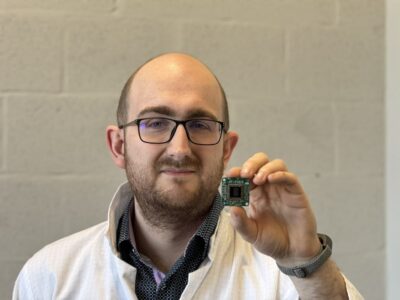
“By applying a few simple rules, many EMC tests become achievable, which allows the communication between devices using our PCBs and other equipment to run more smoothly and with less interference,” Gybels explains. Applying these rules to Magics’ circuit and chip packaging makes the design process in product development more efficient.
The course material is a good guideline for Gybels himself, and it helps explain to colleagues how EMC actually works and why certain choices are better than others. Moreover, he now has a good idea of what to look for when he encounters an EMC problem for which he does not yet have an answer.
Gybels would recommend the training for companies that do not yet have in-house expertise in EMC design. “It provides a solid foundation and then goes into depth in a useful way. The learning curve is not very steep. Someone who already has the basics may benefit more from a follow-up course.”
For Gybels, this training provided exactly the right information to apply to his work. Moreover, he now has sufficient insight into where to find additional information if needed. He was very satisfied with both the training and the provider. “We are expected to take a course or training every year, so I will definitely see if High Tech Institute has any more interesting topics relevant to my field.”
This article is written by Marleen Dolman, freelancer for High Tech Systems.