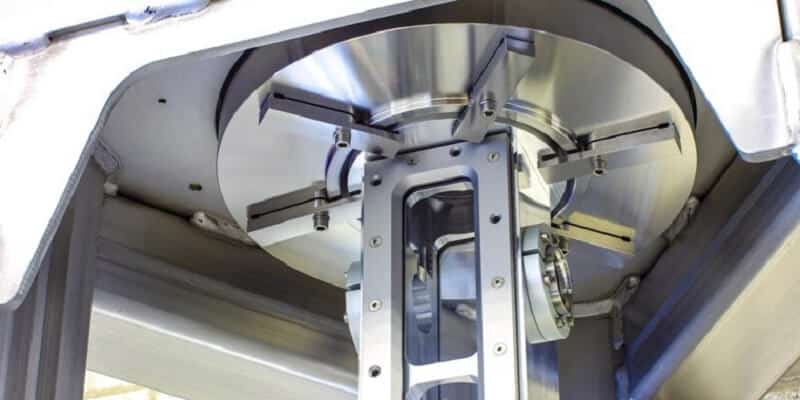
Bearing Principles for Precision Motion

In precision motion systems, the focus is often on the actuated degrees of freedom (DoF) since these involve actuation, position sensing and motion control. In most/many cases, however, the non-actuated, constrained DoFs are equally important since these are exposed to similar disturbance forces as the actuated DoFs and accuracy requirements are comparably challenging.

Known solutions for constraining degrees of freedom in precision motion systems are roller bearings, flexure bearings, gas bearings and active/passive magnetic bearings, but what technology fits your application best? In order to answer that question one needs to understand the essence, pros/cons and limitations of each of these bearing technologies.

In CD players that were developed in the 1980s, originally, a swing arm supported by roller bearings was used to move the optical pick-up unit from the inner to the outer radius of the disk and to accurately follow a particular track. In later generations, driven by a smaller pitch and tighter accuracy requirements, the swing arm was replaced by a translational guide way based on sliding contacts for coarse positioning, combined with a flexure bearings for fine positioning of the pick-up unit in radial and focus direction.

Typically, when designing precision motion systems, various design parameters have to be balanced and simultaneously optimized, such as range of motion, accuracy and reproducibility, stiffness and damping. Although sliding and also rolling contacts suffer from stick-slip behaviour and (virtual) play, cost and complexity are low and performance might be good enough for coarse positioning. When low friction and hysteresis is required, or strict requirements on particle generation hold, it may be advantageous to fully separate surfaces via full film bearings, either aerostatic or hydrostatic. For large range of motion in vacuum conditions, such as in electron microscopes, E-beam inspection or EUV lithography systems, active magnetic bearing systems (AMBs) are highly advantageous. Despite higher cost, these systems have the additional advantage that frame vibrations can be isolated from the motion stage. When only small translations or rotations are required, flexure bearings can provide excellent reproducibility, particularly if manufactured monolithically. These bearings, however, suffer from parasitic stiffness and have very little damping.

This course will focus on the design, modelling and implementation of bearing elements in precision motion systems. We will discuss the trade-offs between performance on the one hand, and cost and complexity on the other hand. Both passive and active bearing technologies will be extensively discussed. We will focus on different application areas, such as medical equipment, machine tools, scientific instrumentation and semiconductor applications.

Design Principles Masterclass

Within high tech companies many designers are dealing with mechanical, optical and mechatronic challenges. The complexity of their design challenges can be big, which makes it difficult to guarantee design solutions at a satisfactory level.

In this master class designers bring their personal design challenge with them. Together with experts in the field and the other course participants they bring their challenge to a solution. Before the start of the programtrainers and participant meet and discuss the design challenge they would prefer to tackle. Our experts focus on composing the right mixes of course participants and how to deal with confidentiality aspects in an adequate manner.

During the master class experts from various disciplines will be invited to add specific knowledge to the program.

Mechatronics System Design – Part 1

Part 1 of the course ‘Mechatronics system design’ focusses on the essential basics in any multi-disciplinary development of mechatronic (motion) system. In this applied mechatronics training, participants will acquire broad technical knowledge beyond the limits of their own discipline. 

What makes this training unique:

  • The leading training with over 3500 enthusiastic participants.
  • Mix of well-known university professors and industry experts.
  • Variety of practical experiences and lessons learned from multiple application areas.
  • Recommended by euspen & DSPE (European/Dutch Society for precision engineering).

This training is available for open enrollment as well as for in-company sessions.

Metrology and Calibration of Mechatronic Systems

This course focuses on the various aspects related to metrology and calibration of precision modules/systems. Participants will acquire theoretical background and practical insights incl. do’s & don’ts – both on system design level as on detailed engineering level – related to metrology and calibration that are essential to successfully develop and build precision modules/systems.

This training is available for open enrollment as well as for in-company sessions.

Advanced Mechatronic System Design

Participants will gather physical insights, way of working, design concepts and lessons learned (in terms of approach and in application specific technical problems and solutions), which play a role in the development of precision systems. 

The participants will be confronted with aspects on different levels, e.g. the global product creation process including interaction with the customer (and the fact that the customer is in fact multiple persons with sometimes different views), technical trade-offs on system level and recent insights/developments on module/function level. 

The training is set-up in a masterclass manner with a mix of presentations and exercises in combination with a conceptual design case study of a precision system, typically for lithography or inspection purpose, which will be worked on in teams throughout the course including a customer presentation at the end of the course. 

Design Principles for Precision Engineering

The training focuses on the fundamental principles concerning the behavior of mechanisms and how this behavior can be predicted and improved. The learning goal is that after the training the participants are able to recognize, identify and evaluate the fundamental aspects concerning the behavior of mechanical designs. 

This training is available for open enrollment as well as for in-company sessions.

Motion Control Tuning

Motion control is essential in any application where accurate and fast movements take place, or where motional disturbances should actively be attenuated. Important examples include positioning a product in a manufacturing line, printing on a sheet of paper, lithographic imaging processes, as well as precision scientific instruments such as atomic force microscopes or astronomical instruments. In this course, you will learn how to perfectly tune such a motion control system in a couple of minutes.

To this end, you will learn both the application aspects of mechanical systems, as well as the required theoretical foundations, where Nyquist and Bode diagrams are demystified. The course consists of alternated sessions of theory and application to a motion system, where you will immediately be able to apply and test your newly developed knowledge in practice.

The course content includes the fast identification of frequency response function models in closed-loop, and appreciate their usefulness by comparing these with time domain approaches. You will be able to interpret these frequency response functions and link them to the physical behavior of the mechanical system, where collocated and non-collocated actuators and sensors are a key aspect. The next aspect is to use these frequency response function models for designing controllers. You will learn to tune PID (proportional-integral-derivative) filters, as well as notch and low-pass filters. Frequency domain techniques are used to specify requirements and assessing closed-loop stability, for which you will learn how to use Bode diagrams and Nyquist plots. Your newly developed skills will be directly tested in the loop-shaping game, where you are challenged to tune for the highest performance and compete with the other attendees of the course. In the final part of the course, the performance limitations are further investigated, and further appreciation is given to the collocated and non-collocated control situation. Furthermore, the feedback controller you have designed is complemented with a feedforward controller. Again, a systematic tuning procedure is developed in the same spirit: it allows you to perfectly tune the feedforward controller in a few minutes. In the final session, an outlook is given on extensions, including multivariable feedback loops and learning techniques for automated tuning.

This training is available for open enrollment as well as for in-company sessions.

\"\"

Advanced Feedforward and Learning Control

Do you also have a motion system that has the same error for each task? Have you also been inspired by the many recent successes of learning, and want to investigate what learning for your machine could imply? Or are you excited about advanced motion feedforward control that even includes the 4th derivative of the set point signal? This course enables you to improve the performance of your system by advanced feedforward and learning control by learning from data.

In recent years, classical feedback controllers and feedforward controllers have been further developed towards advanced feedforward. This includes the use of higher-order derivatives of the setpoint signal, including jerk, snap, etc. In addition, the use of input shapers and rational feedforward controllers allows an even better performance, where new techniques have been developed to calculate such signals.

In addition, a lot of new results have been obtained at the intersection of control and machine learning. Successful developments include techniques that are related to iterative learning control and repetitive control, which applies to industrial systems, including pick-and-place machines or batch processes that perform the same task over and over again. When exactly the same task is performed, disturbances act on the system identically over the tasks. Think, for instance, about a disturbance torque profile, from unbalance in an axis, or from unknown friction effects. The key idea is these learning control techniques can completely compensate for these disturbances, leading to a typical order of magnitude reduction of servo errors. These techniques can achieve perfect performance. In addition, in recent years, these have been further extended to learn the optimal parameters of advanced feedforward controllers, i.e., using higher-order derivatives, input shapers, and even rational feedforward controllers. In addition, major developments include the use of techniques from machine learning, including Gaussian Processes.

This new and extended course starts by recapitulating classical feedforward, and covers an in-depth treatment of iterative learning control, repetitive control, and new advanced feedforward approaches, some of which are at the intersection with machine learning techniques. The course covers:

  • theory, e.g., understanding the convergence of learning control from classical feedback;
  • design, learning how to design advanced feedforward and learning from typical motion control design approaches (loop-shaping);
  • connections to new developments and being able to understand their relevance, including recent ideas from machine learning;
  • algorithms, full coverage of tailor-made Matlab-algorithms (with possibility to take these home).

This training is available for open enrollment as well as for in-company sessions.

\"\"

Basics and Design Principles for Ultra-Clean Vacuum

Since vacuum is unknown in daily life, no reference framework exists for those who are not involved in this technique. To acquire the necessary level of understanding the trainees will be introduced to the basic principles of vacuum technique as well as in the required design principles to achieve ultra-clean vacuum conditions.

Key issue is to become aware of the fact that the whole chain of design, machining, cleaning and the assembly of the components is an integrated process which is as strong as the weakest link in the production chain. 

This training is available for open enrollment as well as for in-company sessions.

Dynamics and Modelling

Basic course into the various aspects of machine dynamics that influence the performance of mechatronic precision systems..

This training is available for open enrollment as well as for in-company sessions.