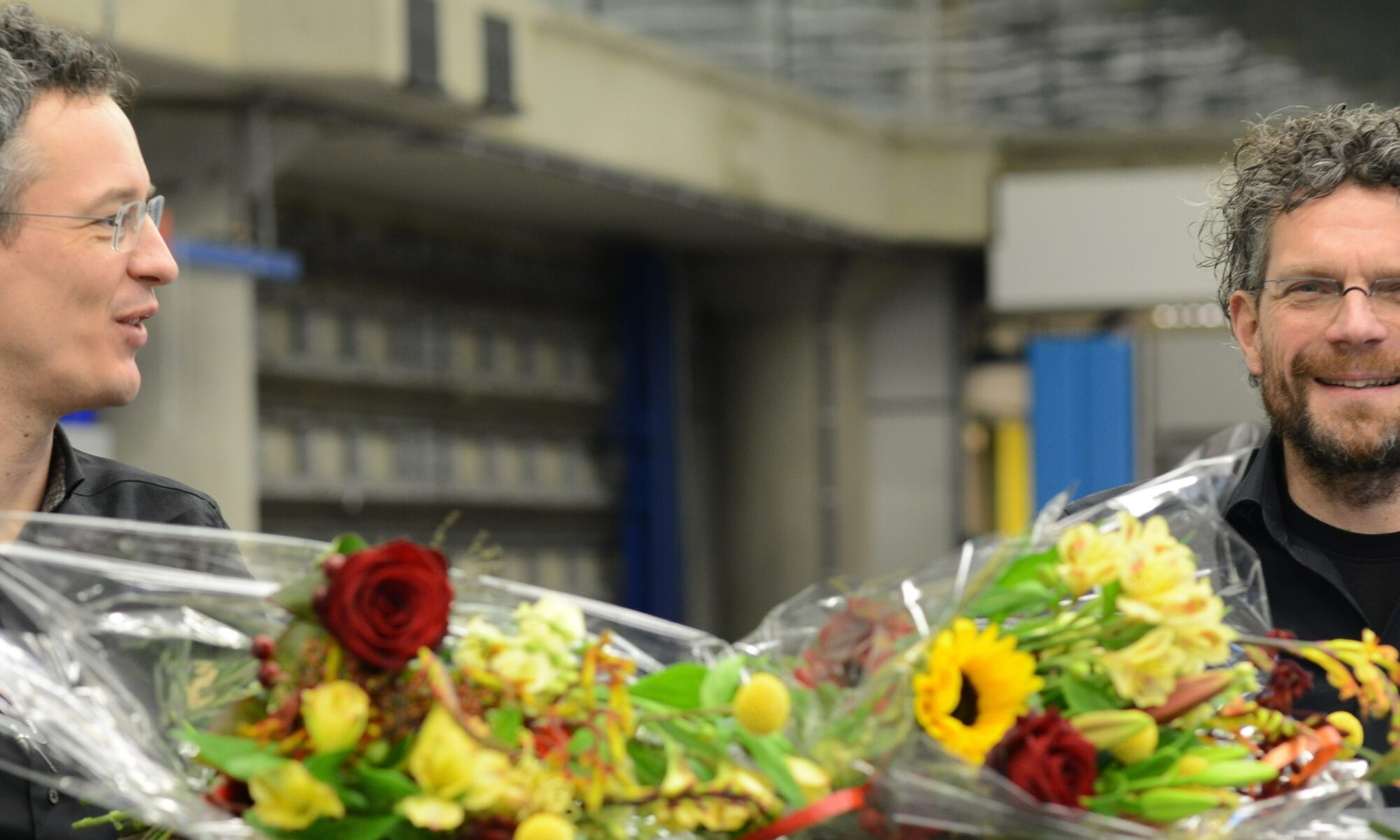
Robert Deckers elected as High Tech Institute’s “Teacher of the Year”

Robert Deckers is Teacher of the Year
Robert Deckers EngD PhD was announced as “Teacher of the Year” during High Tech Institute’s annual get-together in Eindhoven. His training last September scored high praise and an overall rating of 9.2, as he notched a 9.7 for him as lecturer.

In September 2023, Robert Deckers delivered an edition for open enrollment of his ‘Good Software Architecture’ training to a group of 6 participants. When asked for a recommendation score, participants responded with an emphatic 9.3 points out of a possible 10, and handed the lecturers a score of 9.7. Respondents also offered several praising comments. “Clear explanation and useful assignments,” one of the trainees commented. Another pointed out that the theory was very good with good coupling to daily practice. Other positive comments: “Good lecturer who provides useful tips on the students’ own cases” and “I left inspired.”

Robert Deckers is architecture consultant and coach and is currently also doing research. He developed the “Good Software Architecture” training which is available through High Tech Institute. The 4-day course is intended for people with a technical software background growing towards the role of software architect.

The selection of the “Teacher of the Year” award is based on all training evaluation forms in a specific year. Each trainer can only be elected once every 5 years.


René Raaijmakers congrats Robert Deckers with his title ‘Teacher of the Year’. 

Hans Vermeulen and Kees Verbaan elected as High Tech Institute’s “Teachers of the Year”

Hans Vermeulen and Kees Verbaan were announced as High Tech Institute’s “Teachers of the Year”. Their in-company training scored high praise and an overall rating of 9.7, as the duo notched a 9.9 for them as lecturers.

In October 2022, the duo was asked to come to Wilton in the USA to deliver an in-company edition of the Passive damping for high tech systems training to a group of 17 employees. When asked for a recommendation score, participants responded with an emphatic 9.7 points out of a possible 10, and handed the lecturers a score of 9.9. Respondents also offered several praising comments. “Thoroughly enjoyed the whole course,” one of the trainees commented. Another pointed out that there was a good blend of theory and practical case studies. Other positive comments: “An excellent course. I am glad that I was able to attend” and “Great hands-on exercises and great engagement with audience and interaction.”

Prof. Hans Vermeulen is senior principal architect EUV-optics at ASML and part-time full professor at the Technical University Eindhoven. Dr. Kees Verbaan is system architect at NTS Group, a first-tier supplier for high tech machine design. They are both part of the lecturing team for the “Passive damping for high tech systems” training of Mechatronics Academy. The 3-day course for all engineers involved in high precision motion systems who want to gain more insight into the possibilities and limitations for the applications of passive damping.

The selection of the “Teacher of the Year” award is based on all training evaluation forms in a specific year.

This article is written by René Raaijmakers, tech editor of Bits&Chips.

Modernizing your code base with C++20

Modernizing your code base

Free webinar 2 February 2023

On February 2, 2023, from 4 – 5 PM, High Tech Institute organized a free webinar on ‘Modernizing your code base with C++20’. The webinar was given by Kris van Rens, trainer of the new C++ Fundamentals training.

Click here to watch the recording of this webinar.

To go directly to the presentation slides:
Kris van Rens – HTI – Modernizing your code base with cpp20.

Objective

As many production tool chains now adopt C++20 features, the potential this language version brings is unlocked. What advantages can recent versions like C++20 offer to your code base? In this session we will take a look at the great improvements C++ has gone through lately, and look at how features like concepts and ranges can transform your code.

Intended for

Professionals in software engineering, level beginner to advanced, interested in C++.

Webinar program ‘Modernizing your code base with C++20’

  • Intro
  • Global overview of C++20 features
  • In-depth examples of concepts
  • In-depth examples of ranges
  • Conclusion

Trainers

Kris van Rens


Trend 5: Tooling

Trainer System Requirements Engineering
High Tech Institute trainer Cees Michielsen highlights a handful of trends in the field of system requirements engineering. He provides the 2-day training System requirements engineering improvement for High Tech Institute several times a year.

In each System requirements engineering improvement training the question arises: what it the best tool to manage our requirements? To answer this question you would need to know all the bells and whistles of requirements management tools, including the latest updates. At the same time, you need a good understanding of the operating environment where you want to insert the tool. In short: this is an impossible task.

Don’t stress, there is still a first distinction to make. It is best to do that based on the type of business you are working with. An organization like ASML is not required to conform to international safety standards, information security or FDA regulations. Even Word or Excel is then suitable to manage everything – and surprisingly this seems to be the preference.

When norms and regulations are involved, the software must support audit trails. That means providing basic functionality for configuration management, like version management, change management and status administration. It’s quite amazing, but many requirement management tools don’t provide these basic features.

Another distinction to make is the baseline. In its most basic form, a baseline is a snapshot of the requirements database, containing a subset of requirements. More advanced tools provide workflows to select specific requirements with specific characteristics from the database. Such a baseline can be reviewed, modified, approved and released as a separate entity in the tool. Once released, the content of the baseline can no longer be changed.

'In its most basic form, a baseline is a snapshot of the requirements database, containing a subset of requirements'

In some industries, like the automotive industry, is the exchange of baselines between OEM and suppliers a standard procedure (better known as the Lastenheft-Pflichtenheft information exchange), but internally it is also useful. They create tranquility and stability in an environment that is known for changing requirements through multidisciplinary product development.

The decoupling of different dynamics from baselines can be very effective. This is also the base of my earlier comment about Word and Excel. They can, with their relatively slow pace of change, dictate an appropriate heartbeat for initiating change in the development organization. For example, a fast-changing agile way of working with biweekly sprints and a long lead time with quarterly updates and annual releases.

A strong argument in favor of using RM-tools, is the traceability support. Most suppliers of tools advertise that their tool is suitable to couple requirements to other requirements. As I wrote in my column on traceability, this doesn’t seem to happen in practice. It is even being discouraged.

Traceability is all about finding the source of requirements. These sources are either a requirements analysis statement or a higher level design decision. Therefore, it is essential that the tool offers the possibility to create other entities than requirements, and is able to make specific relations (trace-links) between requirements and design decisions for example.

Again, you will be amazed at the amount of tools that cannot support this.

In my previous column I presented the W-model in response to the need to assign properties (such as mass and volume) to system elements. You would expect this to be supported by tool suppliers that call their tools Product Lifecycle Management (PLM) like Siemens, IBM, Dassault, Contact Software and PTC. Unfortunately, most of these PLM-tools see their first CAD-drawings as the beginning of the lifecycle of the product. I’m just highlighting it: this is almost at the end of the development process!

'It is essential that the tool offers the possibility to create other entities than requirements, and is able to make specific relations (trace-links) between requirements and design decisions for example'

Put differently: these tools completely skip the left legs of the W-model (from birth to adolescence). In the past years these PLM-tool suppliers have tried to fill the gap by acquiring model-based systems engineering tool providers or by offering interfaces to (Enterprise Architect, Capella, No Magic) and then letting the poor customer deal with the integration and interface issues, while also being left with outdated concepts such as RFLP, incompatible terminology, complete absence of the product properties concept and the lack of the ability for attributes on relationships.

A couple of popular requirements management tools are expanding their functionalities to systems engineering, like Doors, Polarion, Relatics, TopTeam and Jama. They are being confronted with the preconditions that must be met from an SE-perspective: proper configuration-, change- and release management, cross-context traceability, life cycle support for system elements, baselining and more.

Returning to our original topic of the day: I still have to see a RM-tool that does not only support the management aspects, but also the engineering aspects. Like the quantivation of requirements with tags and qualifiers according to Gilb; the relation of functions and function-properties (also to get rid of the outdated split of the functional and non-functional requirements); how to write property-specific requirements; support for ensuring the intrinsic quality of requirements (functionality provided by tools like QVScribe); easy comparison of the system as required, the system as designed and the system as tested. A requirement is more than just a textual description.

In the column about traceability I mentioned that requirements tooling can help with answering the question: why does this requirement exist and why does it have this value? PLM-tooling can help with answering questions such as ‘If this element fails in the field, can tooling help me find the system function(s) affected by this failing element?’

Trainer Hans Vermeulen wins prestigious Rien Koster award

Enthusiastic, hardworking, inspiring, and a team player, these words of praise were given to Hans Vermeulen by Rien Koster when he presented the award which bears his name.

Vermeulen is senior principal architect EUV-optics at ASML, part-time professor at Eindhoven University of Technology (TUE), and trainer at High Tech Institute. The price is ‘for his tireless effort to propagate and innovate the field of mechatronics and precision technology’, said the Dutch Society for Precision Engineering (DSPE).

Vermeulen has an impressive track record within precision mechanics and mechatronics and educating a new generation of precision technologists. After his promotion on precision machining he started at Philips CFT, where he worked with semiconductor equipment, including in the US. In 2007, when ASML took over mechatronics research, he switched to the litho manufacturer. He played various roles within Development & Engineering (D&E) and Research. He was appointed as part-time professor Mechatronic System Design in 2015 at the department of Mechanical Engineering at TUE.

In his field of expertise, Vermeulen pays a lot of attention to the basics, the history, and he also has an eye for new developments. For a long time he was the chair of the Nationale Werkgroep Mechatronica, founded at Philips for distribution and publication of the field.

Two years ago, together with Just Herder from Delft University of Technology and Dannis Brouwer from the University of Twente, he took the initiative to put together a new standard work on design principles. It is an update of the Des Duivels Prentenboek by Wim van der Hoek which has been updated by several leaders in the industry in recent years, under which Koster. The book will appear in 2025 with the title Design Principles for Precision Mechatronics. In the meantime, there is a website live.

The jury called Vermeulen ‘an inspiration, also beyond his technical expertise’. His personal contribution was also emphasized. Vermeulen is able to give his team a lot of room to move forward.


Rien Koster during the eulogy for Hans Vermeulen

The Rien Koster-award goes out every two years to an engineer that has done particularly meritorious work within mechatronics and precision technology. The jury uses the following criteria: oeuvre, creativity, social and commercial relevance and professional appearance. The winner has worked for at least fifteen years in the field, puts theory into practice, contributes to promoting the field and knows how to enthuse colleagues. He/she has shown exceptional competence and creativity and has achieved impressive results, that are acknowledged internally and externally. The Rien Koster-award consists of a money amount, made available by VDL ETG and a trophy made by students of the Leidse instrumentmakers School.

This article is written by René Raaijmakers, tech editor of Bits&Chips.

Enthusiastic and broad audience for 1st System architect(ing) training in Leuven

System architecting training in Leuven

In September 2022, High Tech Institute organized the System architect(ing) training for the first time in Leuven with open enrollment format. The group of fifteen participants came from seven different companies located in Belgium, Sweden, Germany and the Netherlands. The training scored 8.7 out of 10 when asked for recommendation to others.

Luud Engels, who got a 8.9 for his contribution as trainer, enjoyed the week with an enthusiastic and engaged group of participants. Some of the participants’ comments: ‘Excellent training’, ‘Thanks for the engaging training’, ‘Very interesting and education course’, ‘I really liked it, it expanded my toolbox.’

The System architect(ing) training is designed to give system architects a clear view of their role and responsibilities in a multi-disciplinary technical development environment. Participants receive instruments (like CAFCR) to tackle architectural issues, for example how to balance the many, often conflicting requirements, and how to set up a roadmap and the basics for creating a business case.

The course gives a complete overview of the broad playing field and a variety of viewpoints that a system architect needs to manage. The training will be organized again in Leuven in May 2023.


Participants having lunch at De Hoorn in Leuven, a welcome change during the intensive training.


Trainer Luud Engels in the middle of his presentation.


Breakfast sessions on model-based systems engineering with Jon Holt

Model-based systems engineering by Jon Holt

On 22 and 23 June, from 8 – 9:30 AM, High Tech Institute organizes free breakfast sessions on model-based systems engineering with Jon Holt

High Tech Institute invites you to sit down in a breakfast session with Jon Holt and a select group of our customers to discuss how to effectively roll out model-based systems engineering in your company. The sessions are scheduled at June 22 in ‘s-Hertogenbosch (at the start of the Sysarch event) and 23 June in Nijmegen. Registration can be done using the form below.

This year High Tech Institute welcomed professor Jon Holt as a trainer in model-based systems engineering (MBSE). Jon will start his first 3 day training edition in October. We are proud to have Jon on board. Holt was identified by the International Council for Systems Engineering (Incose) as one of the 25 most influential system engineers in the last 25 years. He has authored 17 books on the subject.

To get a taste of Jons insights and style you can read the following:


ASPE Lifetime Achievement Award 2021 for Jan van Eijk

Prof. Dr. Jan van Eijk is awarded the ASPE Lifetime Achievement Award for broad-reaching advances in precision mechatronics and for promoting the active sharing of these advances throughout the technical community.

Jan van Eijk accepts the ASPE Lifetime Achievement Award as a representative of the Dutch community in precision engineering.

As a pillar of this community, he has contributed by initiating and heading innovative applied research activities and by active sharing of industrial expertise. This collaborative spirit was first realized in 1989 with the creation of an in-house mechatronics training program for Philips engineers where industrial trainers taught new engineers how to work in multi-disciplinary teams and to employ each other’s technical strengths in order to reach the best overall result. This course has by now educated some 2500 engineers and established a solid foundation as other training programs were created to cover the additional disciplines. Beginning in 2010, these training activities were continued outside of the Philips organization by the establishment of the “Mechatronics Academy”.

He started his education at the Delft University of Technology with a MSc degree in Mechanical Engineering. Following this, he spent three years abroad working at universities in Pakistan and Sri Lanka as a UNESCO associate before returning to Delft to complete a doctoral program that included a dissertation on the design of flexure mechanisms. He received a Ph.D. in Mechanical Engineering in 1985.

Prof.Dr. van Eijk then worked for twenty-two years at the Philips company in their Centre For Industrial Technology (CFT). The Philips company, based in the Netherlands, has been a birthplace of advances in science and technology since the early years of the twentieth century. This Centre formed the knowledge base for mass production technology in Philips. Research done in the “Natlab” was famous and the development of high-throughput manufacturing machines proved to be an important factor in the decades-long growth of the organization. Throughout his career, Jan van Eijk has had the opportunity to build on this foundation and to work with many excellent engineers in the field of high precision mechatronics.

His unique skills and expertise have arisen from the knowledge and experience gained from working at Philips where he became Chief Technical Officer of Mechatronics. While building a mechatronic technology center of about 200 engineers, he made conceptual contributions to a wide range of applications, including optical disc drive systems and lithography systems. With the start of ASML in 1985, Dr. van Eijk contributed to key concepts and to the architecture of mechatronic elements of ASML’s highly successful lithography tools. The use of a rigorous metrology concept, introduced in 1986, formed a significant contribution to the early lithography machines.

After leaving Philips in 2007 he founded his own company, Mechatronic Innovation and Concept Engineering (MICE), to continue to provide consultancy to world-class equipment manufacturers world-wide. He advises not only on technical concepts and designs for systems, but also on how to develop key components necessary for the successful growth of advanced technology organisations.

His skill in explaining sophisticated concepts in a very accessible way was further heightened by teaching for twelve years as a part-time professor at the Delft University of Technology from 2000 through 2012. There he supervised doctoral students on projects related to using active magnetic bearings for precision applications. As a co-author he contributed to the book “The Design of High Performance Mechatronics” written by Prof. Rob Munnig Schmidt. This book gives an industrial perspective on the multi-disciplinary knowledge used in mechatronic engineering.

Jan van Eijk served on the council of euspen and the board of directors of ASPE for several years. In 2012 he was awarded the euspen Lifetime Achievement Award, and in 2016 the DSPE awarded him the Martin van den Brink award for his leading role in the architecting of high-technology systems.


Jan van Eijk speaking at the 2014 DSPE Conference. The winner of the ASPE Lifetime Achievement Award 2021 is committed to sharing knowledge and therefore co-founded the DSPE Conference on precision mechatronics in 2012. (Photo: Jochem Treu)

Free webinar 10 May – System Architect Development Program

High Tech Institute organizes a webinar on 10 May 2021, 5 PM (GMT+2) in which the new System Architect Development Program, called ‘System Architecting Masters’ will be introduced.


The essentials for leadership in highly demanding development environments

The nine months long System Architecting Masters (Sysam) program focuses on practical no nonsense system architecting, as well as the essential leadership skills that are vital to exercise this role as system architect in technical development environments.

Sysam offers a deeply immersive, rigorous experience for professionals in research, development and engineering organizations who are committed to driving meaningful change within themselves, their teams, and their organizations. Check out the entire description here.

For whom?

Professionals in a technical development and engineering environment with:

  • at least five years of experience
  • at least half a year experience in a system architecting or system engineering role or a leading position that requires you to communicate with a team, customers and management
  • an ambition to bring your leadership skills to a higher level and improving your overall effectivity

Indicators
Sysam helps you to avoid common pitfalls in system development and engineering. You might recognize some them the mentioned below.

  • timing is a problem. Projects run late and over budget;
  • products do not meet the requirements the client needs;
  • technical decisions are done too much separately from other important aspects of the business;
  • technical leaders are not visible enough in the organisation;
  • it is not clear where the responsibilities of the system engineer or system architect starts and ends;
  • systems do not meet the stakeholders expectations, not only from a functional, but especially from a quality point of view.
Webinar outline


Essential training for technical leadership in highly demanding development environments

System Architecting Masters program
High Tech Institute is starting an intensive System Architecting Masters (Sysam) training program for system architects and system engineers. Ger Schoeber and Jaco Friedrich offer aspiring professionals a robust program of training and coaching on their own projects for nine months.

The System Architecting Masters program consists of three intensive blocks of training of four days each with several months in between for assignments on the job, coaching and peer review. Half of the training itself consists of essential system engineering and system architecting topics. The other half consists of intensive exercises with practical situations, such as convincing stakeholders and being able to turn resistance into buy-in.

There are several months between the four-day training blocks, during which Schoeber and Friedrich coach the participants. Intermediate sessions are also planned where the participants exchange experiences with each other.

To ensure quality, the number of participants in Sysam is limited to a maximum of twelve. This also ensures that participants can effectively exchange experience about their projects.

If you want to enhance your leadership skills and push projects a big step forward, check out the entire Sysam program.